I haven’t made a video or written a blog or even just sat down with my own thoughts for a while and I’ve really missed it. So I started devoting time to myself again, in an effort to feel in charge and do things I love and not only work (although I do love my job!).
I made a short video and details and you can find details of what I mentioned below.
2. I’ll create a short series of videos with useful expressions in the Cypriot dialect, as requested in a comment. In the meantime, if you need to learn Greek fast, you can use freely available material here: https://www.volutoring.eu/EN/
How many times have you been asked “What do you do for a living”?
If you are an adult, probably hundreds of times and if you are a non-native speaker it’s not always easy to answer this question. The mind sometimes gets stuck and you end up blurting out the first thing you think which might not be necessarily correct.
So here’s some expressions you can use when asked this question.I hope you find it useful!
A fellow EFL teacher asked me to make a video on pronunciation and mistakes different speakers of other languages make in English. Since I’m Greek Cypriot I started with a video focusing on the most common mistakes Greek Cypriots make when they speak in English.
This took me longer than expected and lots of editing which I’m no expert on but here it is. I hope you enjoy it!
Any feedback and/or suggestions for future videos are always welcome!
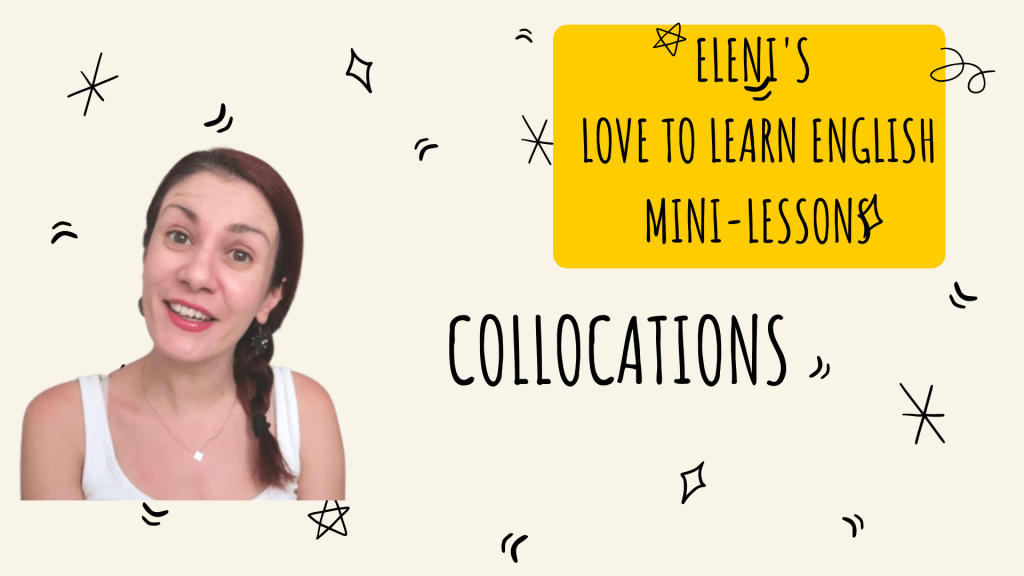
Since I’m stuck in Cyprus for a while, as the global pandemic and being a non-native speaker combination severely limit my options when it comes to EFL teaching destinations, I decided to start a series of mini educational EFL lessons so I don’t forget what I’ve learned so far and remind myself why I enjoy teaching English so much.
There are million of videos out there, so my unique approach is making learning English fun and engaging.
From the start, even during my CELTA course last year, it was important for me that my students actually enjoy the lesson and it’s a positive experience for them. I want them to love learning English hence the title and the comical element of the videos.
So here’s my first ever post. I thought I’d start with one of my favourite topics, collocations.
A few months ago I had no clue what a ‘dogme’ lesson was. When I first heard the term I thought it was something related to either dogs or dogma. Very baffling.
It turns out it has nothing to do with either. A dogme lesson is:
So ever since I’ve heard about it, I really wanted to try it. Why? Because it’s one of the scariest experiences but also one of the most empowering for a newly qualified teacher. We heavily rely on lesson plans, carefully and painstakingly prepared activities and coursebooks, especially in the first couple of months, as that’s the only lesson planning we know how to do
But we often don’t have enough time to plan a lesson as well as we would like to and panic that we might finish a lesson earlier than expected and not know what to do with the remainder of the time.
Therefore, as one may expect, walking into a classroom with zero material it’s terrifying. I really enjoy a challenge though and I firmly believe that every newly qualified teacher should try a dogme lesson. Why?
Improvisation and thinking on the spot are critical if not fundamentally essential skills for an ELT teacher, or for any teacher for that matter and a dogme lesson is perfect to practise both.
And that’s why I decided to give it a go. I’ve built great rapport with my B2 plus adult students over the last year and I thought that would be the best group to try it with.
After consulting a senior colleague (thank you James!) for valuable advice and much needed encouragement I was ready to experiment.
You can have a semi-dogme lesson, going into the classroom with some ideas which might be better for new teachers, but I as Jame explained it’s not really a dogme lesson if you already have a structure in mind and I really wanted the students to lead the session. I had prepared a back-up lesson just in case it didn’t work out (which helps a lot to know you have a back up) but other than that I left it to the students to decide what they wanted to focus on.
The experience
I find it hard to put into words how it felt to run such a lesson but I’ll try. I was terrified to begin with, but as soon as we started, time flew by and I somehow found ways to facilitate the lesson and provide as much content and language feedback as possible. My students wanted to focus on speaking, so I left it to them to come up with topics. We had 3 pair and group speaking sessions, first each pair or group discussing a separate topic, then focusing on just one. For all the activities I monitored and made notes on good language used as well as language they could improve/express better (which they did) and asked the students to try and use that language on the following activities.
Feedback from my students
I asked my students to give me feedback at the end of it and every single student enjoyed this lesson more than usual because it was on topics they chose and they were interested in. When asked what they enjoyed and what they learned:
And they all enjoyed the lesson more than usual and would like lessons with combination of both their own material and coursebook.
What I learned
Needless to say I was super happy with the feedback and they gave me a couple of ideas on what to improve for next time. I would also like to try and incorporate a grammar language point which would be challenging to do during a free flowing lesson such as dogme, but I’d like to try.
I guess the main lesson I learned from using the dogme teaching approach is that a good lesson doesn’t necessarily need a thorough, detailed lesson plan or a coursebook. Students can learn and enjoy with minimal preparation.
And since then I feel more confident about my teaching and my ability to facilitate a lesson if/when there is no plan or time to plan in detail.
Also I didn’t expect to learn so much from my students and their knowledge of rare spiders that can fly to modern history to emotional intelligence!
I firmly believe a dogme lesson should be part of the teacher training process. Even if it goes horribly wrong it will be a great practice for the real world when you are thrown into a classroom and start teaching and have to deal with situations where you run short of material or technology fails or you just forgot your lesson plan when running from class to class.
Eleni
PS If you’d like to learn more about the dogme teaching approach this is a good start.(link)
PS2 Thank you to my colleagues for the advice and encouragement and my wonderful students who I’ll dearly miss!
I’ve been back to Cyprus for two weeks now and I’m still ‘adjusting’. It’s never been that bad before, maybe because I always had an end date in mind or I had somewhere and something to return to, regardless how gravely I disliked it, or maybe so much happened in the last month alone, my brain is still struggling to fully comprehend what is going on.
But it can’t explain my annoying, pretty much constant (with very brief moments of happiness, laughter and relaxation) irritableness, and no, it’s not hormones.
I’mlike an upset, angry hedgehog, keeping my quills raised, prickling everyone in my way, blindly and indiscriminately.
Why do I feel like this? Why does every single thing upset me? Have I been away for too long? How long can I stick it out for? Should I just find a job in another country and leave ASAP?
Endless questions with no answers. Suddenly, out of nowhere Gaia Vince turned a shining light in this question mark shaped pitch black room.
“This idea that you gain a new personality with every language you speak, that you act differently when speaking different languages, is a profound one.” she writes in a brilliant article discussing the benefits of being bilingual. Ironically from the whole article I focused on one of the disadvantages of being fluent in two languages.
Am I really bilingual since I was born, raised and lived in Cyprus until I was 22 you might wonder. The answer is without a second thought yes. After 10 years of fully immersing in the British culture and way of life, I think and speak in English first.
Apparently bilinguals develop two different mindsets, they are a different person depending on the language they speak at the time (when you add the country they live in AND the language they speak at a given time in the mix that’s when it gets mind-baffling) and those mindsets are always in conflict as the brain is constantly trying to decide which language to use.
My two selves are always in conflict now that I’m back in Cyprus and not just the language parts. The noise, the attitudes, the people, the culture, everything I’d normally enjoy when I’m visiting Cyprus contradict my ‘British self’ who is dominating at the moment and can’t compromise and accept the fact now we are in Cyprus for (hopefully only) a few months it needs to let my other self out more or learn how to live here. My ‘Cypriot self’ is weak though and doesn’t even have an idea on what makes it Cypriot anymore, it hasn’t lived here for 10 years and since it last lived here it was a whole other person, an immature, 22 year old Cypriot who knew nothing about life or herself. That person doesn’t exist anymore but for most of my friends and family that’s the person they knew and sometimes treat me as if I’m that person, which doesn’t help with the eternal battle in my head.
So, I finally have the answer, but what’s the solution?
No idea. Though my ‘British self’ desperately desires to flee, I’m giving it time for now.
If you’ve been in a similar situation and/or wish to share some words of wisdom, please do. In the meantime, I’ll get back into my yoga and try to bring some calmness and tranquillity in this stormy, windy sea of my mind.