‘the’ or ‘a/an’-Eleni’s Love to Learn English mini lessons

For many English language learners using definite (the) and indefinite (a/an) articles correctly doesn’t come easy.

Here’s a quick reminder on when to use which.

Eleni

Time prepositions-Eleni’s Love to Learn English mini lessons

In the summer or on the summer?

At 5pm or on 5pm?

When do we use in, on or at?

Time prepositions can be confusing so watch the video to learn or just revise what preposition to use with days, months, years, dates, seasons etc.

Eleni

Countable and uncountable nouns-Eleni’s Love to Learn English mini lessons

A little game on this week’s video to learn/revise countable (nouns that have plural form) and uncountable (nouns that only have singular form) nouns.

Which of the nouns on the video are countable, uncountable or both?

Eleni

Work-related expressions-Eleni’s Love to Learn English mini lessons

How many times have you been asked “What do you do for a living”?

If you are an adult, probably hundreds of times and if you are a non-native speaker it’s not always easy to answer this question. The mind sometimes gets stuck and you end up blurting out the first thing you think which might not be necessarily correct.

So here’s some expressions you can use when asked this question.I hope you find it useful!

Eleni

Most common pronunciation mistakes of Greek-Cypriot Speakers -Eleni’s Love to Learn English mini lessons

A fellow EFL teacher asked me to make a video on pronunciation and mistakes different speakers of other languages make in English. Since I’m Greek Cypriot I started with a video focusing on the most common mistakes Greek Cypriots make when they speak in English.

This took me longer than expected and lots of editing which I’m no expert on but here it is. I hope you enjoy it!

Any feedback and/or suggestions for future videos are always welcome!

Eleni

10 most commonly misspelled words-Eleni’s Love to Learn English mini lessons

According to Oxford dictionary these are the 10 most commonly misspelled English words.

Can you spell them correctly? Get a pen and some paper and play the video. Post your score below!

Any suggestions for future videos are welcome.

Eleni

Welcome to Eleni’s Love to Learn English mini lessons

Since I’m stuck in Cyprus for a while, as the global pandemic and being a non-native speaker combination severely limit my options when it comes to EFL teaching destinations, I decided to start a series of mini educational EFL lessons so I don’t forget what I’ve learned so far and remind myself why I enjoy teaching English so much.

There are million of videos out there, so my unique approach is making learning English fun and engaging.

From the start, even during my CELTA course last year, it was important for me that my students actually enjoy the lesson and it’s a positive experience for them. I want them to love learning English hence the title and the comical element of the videos.

So here’s my first ever post. I thought I’d start with one of my favourite topics, collocations.

Any suggestions for future videos are welcome!

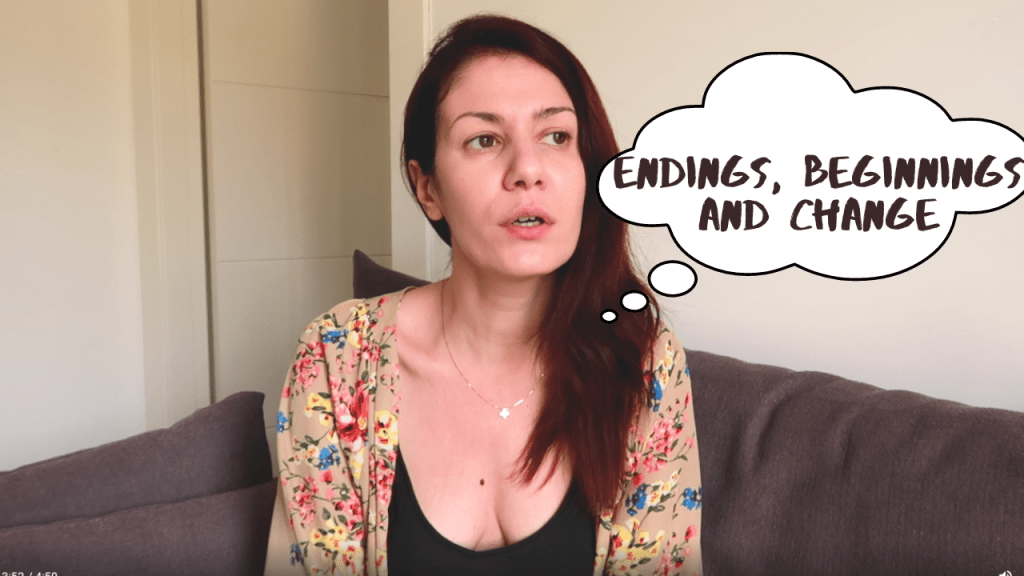
Endings, beginnings and change.

This week’s video it’s all about endings, the end of my first year of teaching English as a foreign language, new beginnings, which at the moment I have no idea what those would be, and change.

I hope significant change. I hope the black lives matter movement keeps going on until we all finally realise our white privilege, our implicit racism as well as racism deeply embedded into every layer of our society, justice system, the world and our responsibility to change that. And the first step: educate ourselves, as sad and uncomfortable it might feel. Imagine if we feel uncomfortable reading and seeing this injustice, how much worse is for the people living it.

I’ve been watching a lot of documentaries lately, at the moment I’m watching Kalief Browder’s story, a poor kid who at age 16 was sent to adults prison. He spent three years at Rikers Island, two of those in solitary confinement for a crime not only he didn’t do, but was never convicted for. After his release he was so scarred from all the abuse he suffered, he committed suicide.

So here is this week’s video

Namaste

Eleni

My first dogme lesson

A few months ago I had no clue what a ‘dogme’ lesson was. When I first heard the term I thought it was something related to either dogs or dogma. Very baffling.

It turns out it has nothing to do with either. A dogme lesson is:

(Wikipedia)

So ever since I’ve heard about it, I really wanted to try it. Why? Because it’s one of the scariest experiences but also one of the most empowering for a newly qualified teacher. We heavily rely on lesson plans, carefully and painstakingly prepared activities and coursebooks, especially in the first couple of months, as that’s the only lesson planning we know how to do

But we often don’t have enough time to plan a lesson as well as we would like to and panic that we might finish a lesson earlier than expected and not know what to do with the remainder of the time.

Therefore, as one may expect, walking into a classroom with zero material it’s terrifying. I really enjoy a challenge though and I firmly believe that every newly qualified teacher should try a dogme lesson. Why?

Improvisation and thinking on the spot are critical if not fundamentally essential skills for an ELT teacher, or for any teacher for that matter and a dogme lesson is perfect to practise both.

And that’s why I decided to give it a go. I’ve built great rapport with my B2 plus adult students over the last year and I thought that would be the best group to try it with.

After consulting a senior colleague (thank you James!) for valuable advice and much needed encouragement I was ready to experiment.

You can have a semi-dogme lesson, going into the classroom with some ideas which might be better for new teachers, but I as Jame explained it’s not really a dogme lesson if you already have a structure in mind and I really wanted the students to lead the session. I had prepared a back-up lesson just in case it didn’t work out (which helps a lot to know you have a back up) but other than that I left it to the students to decide what they wanted to focus on.

The experience

I find it hard to put into words how it felt to run such a lesson but I’ll try. I was terrified to begin with, but as soon as we started, time flew by and I somehow found ways to facilitate the lesson and provide as much content and language feedback as possible. My students wanted to focus on speaking, so I left it to them to come up with topics. We had 3 pair and group speaking sessions, first each pair or group discussing a separate topic, then focusing on just one. For all the activities I monitored and made notes on good language used as well as language they could improve/express better (which they did) and asked the students to try and use that language on the following activities.

Feedback from my students

I asked my students to give me feedback at the end of it and every single student enjoyed this lesson more than usual because it was on topics they chose and they were interested in. When asked what they enjoyed and what they learned:

And they all enjoyed the lesson more than usual and would like lessons with combination of both their own material and coursebook.

What I learned

Needless to say I was super happy with the feedback and they gave me a couple of ideas on what to improve for next time. I would also like to try and incorporate a grammar language point which would be challenging to do during a free flowing lesson such as dogme, but I’d like to try.

I guess the main lesson I learned from using the dogme teaching approach is that a good lesson doesn’t necessarily need a thorough, detailed lesson plan or a coursebook. Students can learn and enjoy with minimal preparation.

And since then I feel more confident about my teaching and my ability to facilitate a lesson if/when there is no plan or time to plan in detail.

Also I didn’t expect to learn so much from my students and their knowledge of rare spiders that can fly to modern history to emotional intelligence!

I firmly believe a dogme lesson should be part of the teacher training process. Even if it goes horribly wrong it will be a great practice for the real world when you are thrown into a classroom and start teaching and have to deal with situations where you run short of material or technology fails or you just forgot your lesson plan when running from class to class.

Eleni

PS If you’d like to learn more about the dogme teaching approach this is a good start.(link)

PS2 Thank you to my colleagues for the advice and encouragement and my wonderful students who I’ll dearly miss!

Conditionals in songs

Most EFL teachers do not enjoy teaching grammar but conditionals is probably one of the very few grammar points that is super easy to make fun to teach.

I personally love songs and drama and I try to use it in my teaching as much as possible so I was looking for an audio or a video that included all four conditionals to use with my FCE class as a revision.

I couldn’t find any so I put together one myself using a web app. It didn’t take that long actually, what it took the longest was choosing songs as there are a LOT of great songs with conditionals in their lyrics.

I thought I’d share in case you are in a similar position and you find this in any way useful. Below are the audio and the lyrics for each song snippet I used (you can turn it into a gap fill or listening activity or just as a warm up).

Let me know what you think!

PS I don’t own copyrights for any of these songs.

Eleni