How anxiety feels like…

June 2014

I woke up soaking wet in sweat, it happens a lot lately…

I’m flying home today, after 4 years, is that true? It can’t be true. I’m excited but paralysed of fear. Nervous, shaking, I feel I’ll throw up any minute now. ‘What if the plane crashes?’, ‘What if my head explodes?’, ‘What if I have an infection and my appendix blows up on the plane?’ The beast has awaken once more…

I used to love flying. Absolutely adored it. And now, now I’m dreading it so much I may faint at any point on my way to the airport.

I was to fly home with my ex-boyfriend. We were together for 5 years and he hasn’t visited my home country yet. I’ve booked a hotel in Paphos and planned daytrips  to show him around. But his passport got washed by accident, he needed a new one, the Greek Embassy in London is ridiculously horrible blah blah blah. I don’t think he ever had any desire to come with me anyway…

I still really wanted to go despite my severe anxiety attacks and my extremely, hit rock bottom confidence. I’ve put on weight, I was unhappy, I hated my body, my daily routine, I hated myself.  Costas and I argued a lot, I rarely felt appreciated and although I told him about my troubles he couldn’t help me. He was dealing with depression himself.

I did well to hide it from my family and my friends. I smiled, I joked as if everything was OK. But inside. Inside, the pain was real. I struggled almost every day, I was scared to do anything and my anxiety also developed to hypochondria. I often diagnosed myself with cancer. The pain was not just mental, it was physical. My breast hurt, my teeth hurt, my head hurt, everything hurt. My mind made my body hurt to convince me I was gravely ill.

That’s what anxiety does to you. It blurs your mind. It turns simple daily tasks into a nightmare, it makes you paranoid, it makes you scared to leave the room. It’s painful. Your head, your brain, your mind hurts. Everything hurts. It’s noisy, never quiet in there and that drains you. It sucks the life out of you.

But I made it. I made it home. And I ended up staying three weeks instead of two and had the best time ever. A friend’s wedding, my sister’s birthday, days at the beach, daytrips around the island, my sister and her friend taking part in a TV music show, severe sunburn. A three week ray of sunshine in my grey, miserable life.

That was the very first time I realised I was in a dead end relationship and I also needed help. But right now the only one who could really help me was myself. Or I thought that nobody else would because I did not want to ask for help from anyone. ‘Who can I ask? I don’t have any close friends in Southampton and I don’t want to worry my family or my friends.’

After I went back I was in tears daily, fighting with my worst enemy, myself to put these irrational thoughts aside and get out of this dark hole.

And I made it. I joined the workplace choir, I started exercising and improved my diet and I later joined SingNow choir which was a turning point for me. I met my best friend, my Sheba, I’ve made great friends and that’s what opened my eyes to the beauty and love I missed out of for years because I was told to ‘be careful what you tell others about us’, ‘lose weight’, ‘you can’t do this’, ‘that’s not good enough’.

I still had bad days.

Anxiety and depression never go away. They are always there at the back of your mind and they make their appearance again when you least expect it, when you are already down on your knees, crying your eyes out, because life got too much again…

After the breakup and my aunt’s death I was in denial and avoided even the tiniest opportunity to deal with the demons that tormented me for years. I was out all the time, drinking, travelling, avoiding any time with myself. I was not used to being on my own, let alone on my own with two of my least favourite friends residing in my brain.

It finally caught up with me about a year ago. It slowly started in November but it reached its worst point in January. I couldn’t eat, I didn’t want to go out, I didn’t want to see anyone. I quit SingNow and stopped going to the workplace choir, I  turned down any invitations from friends. I isolated myself from everyone. Although I was scared. Terrified. Daily things stressed the hell out of me, getting dressed, making dinner. I often skipped eating completely. I was not hungry anyway.

‘What if I die? Nobody will miss me. At least it will put an end to this pain.’

After I’ve written about it, I pushed, no, I forced myself to get out of it. I slowly crawled out of the hole, towards the light… I re-joined the workplace choir and I went home for a week in April which helped immensely. I didn’t have to worry about trivial things I worried when I was on my own, like ‘Have I left the iron on?’, ‘What if someone breaks in whilst I’m asleep alone at home?’ (I lived on the third floor, highly unlikely).

I decided to take part in the One Sound show, although I still suffered from anxiety attacks. It was different this time around. The year before I was excited and I couldn’t wait, the pros of the denial stage, you feel fearless… for a while.. but this time I was terrified. I cried when I went home after the big rehearsal. Seeing my SingNow friends after months, hugging me, asking me how I was, it was so overwhelmingly beautiful. I was worried even going to the rehearsal, thinking they may hate me.

The show was incredible although I struggled the whole time. I smiled but in my head the noise was louder than the noise of 300 choir singers backstage. Deafening.

2018-05-14 18.28.48.jpg

I now feel much better. With the help of my incredible, loving, caring colleagues, friends and family but mostly myself I made it to the other side.

There are still times or days I panic and worry about the most meaningless, little things or I feel down but I now know how to help myself get out of it. I know how to cope with it because I never want to hit rock bottom again.

Writing about it, music, yoga, mindfulness, finally loving and accepting myself, talking through it and lots of love from my nearest and dearest are my remedies.

Asking for help and sharing your irrational, crazy or unbelievably sad and depressing thoughts it’s not easy, it may well be the hardest thing of all to do, but it’s the most liberating feeling I’ve ever experienced.

Next time you see someone smile or laugh, do not assume they are OK. They may be fighting a demon inside… This is a snap of me from 2014, at my worst. Would anyone guess from this what was happening in my fucked up mind?

Smiling but dying inside

I hope one day mental illness is taken as seriously as any other illness and nobody is ashamed or scared to share their story.

Namaste

Eleni


Not waving but drowning…

Last Friday I attended an inspiring, thought provoking talk on mental health by Hugh Clarke, the Former Head of Counselling services at London Met and counselling Psychologist, as part of the CPD series of workshops run by the Southampton Learning and Teaching Institute at the Uni.

Hugh started the session by guiding us into a three minute mindfulness exercise. I’ll describe how I felt after the instructions below, in case you want to try it, I don’t want to influence you. Read all the steps first as after you close your eyes, you won’t be able to see the rest.

  1. Sit comfortably with your whole feet touching the floor and let your hands gently rest on your thighs.
  2. Close your eyes. What  can you see? Now focus your attention on your breath. Then move to the sounds inside the room. What can you hear? What can you smell?
  3. Now focus on the sounds outside the room, what else can you hear?
  4. Now move back into the room and pay attention to your body. How do your hands feel on your legs?
  5. Now shift your attention to your internal body. What did you notice? Your heartbeat?Can you feel your blood flooding through your veins at every corner of your body?
  6. Now gently open your eyes.

How did that feel?

I felt relaxed, calm and fully concentrated, ready for the talk.

Hugh continued with a question, how we thought someone who is about to take their own life may feel.

My first thought was relief. Relief and calmness, as they can now put an end to their suffering. Others said a sense of control, as this is something they have control of. It made us all think.

He then played us a clip of Stevie Smith, reciting ‘Not waving but drowning’, the poem that inspired the title of his talk.

and then showed us a picture of the infamous Landscape with the Fall of Icarus painting.

Landscape with the fall of Icarus

Icarus, based on my beloved Greek Mythology, fulfilled his dream of flying with wings out of feathers and secured with bee wax his father Daedalus made. His father warned him not to fly near the sun, but he ignored him, so his wings started melting and Icarus tragically fell and drown into the sea.

Can you see him in the painting? Maybe not at first. Everything seems normal, everyone getting on with their day and Icarus actually looks like waving, but he is drowning.

And that’s what happens in every day life. Signs of struggling and mental illness are not obvious most of the time.

Hugh went through staggering statistics on student and general population mental health in the UK. Some of the ones I noted down:

-There are over 250 labels used to stigmatise people with mental illnesses. Unbelievably sad.

Labels used to stigmatise people with mental illnesses

-27% of students reported they struggled with mental health issues.

-77% of students who reported they dealt with mental health issues were suffering from depression and 74% struggled with anxiety.

-The number of students and the severity of mental illnesses they struggle with it’s been increasing year after year, now at its highest.

-A survey of a major UK university revealed that 40% of their students were ‘detached solos’, students alone and isolated.

The stats for the UK general population are equally sad:

-There’s been a 43% increase of use of anti-depressants.

-75% of people who commit suicide have never asked for help.

-For men under 35, the most common cause of death is suicide.

What’s causing mental illnesses? That’s of course a complex question, is not just one thing, and it’s different for each individual.

But some of the main reasons (other than the immediate family environment and upbringing): society, local economics, fragmentation, helpless resentment, the ‘Buffoon effect’ (e.g. Donald Trump), social media (comparison with others which can reduce self-esteem), tyranny of perfectionism, tyranny of the ‘should’ (we all suffer from this to some degree!)

Causes of mental illness

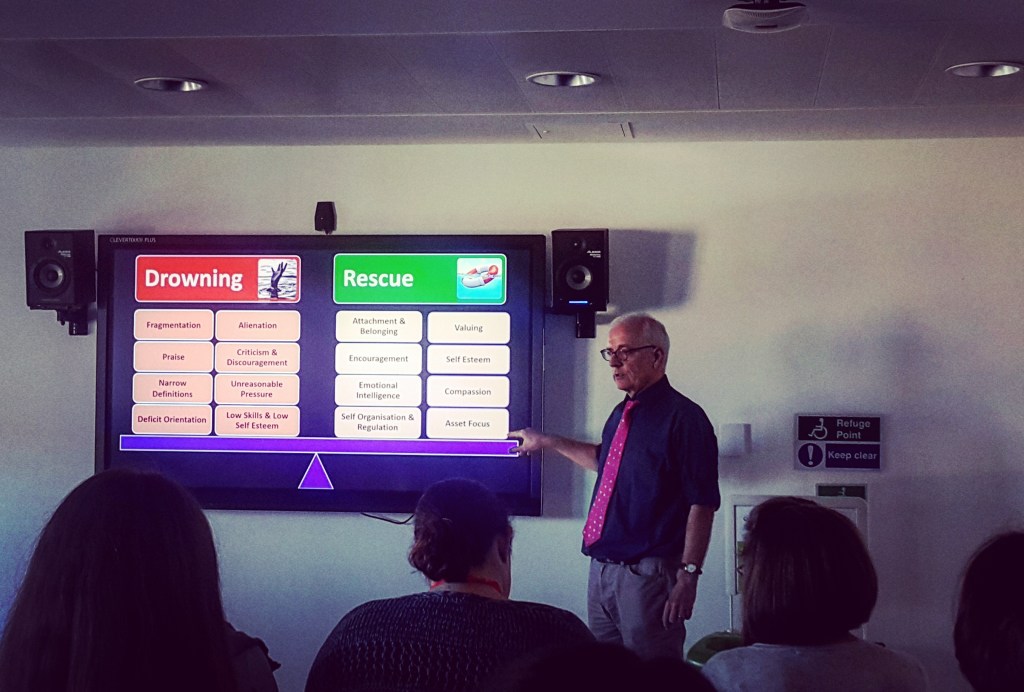
So how can we help each other?

Develop supportive climates through empathy, spontaneity and equality. Be compassionate and encouraging. The sense of belonging, feeling valued and self esteem are vital. And of course emotional intelligence.

At that point Hugh ran out of time as we bombarded him with questions but emotional intelligence, contrary to general intelligence, can be increased throughout our life. Self-awareness, your relationship with yourself and others, recognising and controlling your feelings can all improve with practice. And that can benefit one’s life in so many different ways, I need a whole post for that.

Hugh intended to finish his session the way he started it. Practising mindfulness.

A 3 minute mindfulness exercise has been scientifically proven, not surprisingly, to significantly reduce stress (which confuses us and doesn’t let us concentrate, it makes everything blurry) as it focuses our attention to ourselves, to the present and our nervous system comes back to a calm, neutral state and we can think more clearly.

What a brilliant talk. I’m sure if we had more time we would have been there for hours.

I hope you enjoyed this. I definitely enjoyed it and learned a lot from it.

Namaste

Eleni