A little game on this week’s video to learn/revise countable (nouns that have plural form) and uncountable (nouns that only have singular form) nouns.
Which of the nouns on the video are countable, uncountable or both?
Eleni
A little game on this week’s video to learn/revise countable (nouns that have plural form) and uncountable (nouns that only have singular form) nouns.
Which of the nouns on the video are countable, uncountable or both?
Eleni
How many times have you been asked “What do you do for a living”?
If you are an adult, probably hundreds of times and if you are a non-native speaker it’s not always easy to answer this question. The mind sometimes gets stuck and you end up blurting out the first thing you think which might not be necessarily correct.
So here’s some expressions you can use when asked this question.I hope you find it useful!
Eleni
A fellow EFL teacher asked me to make a video on pronunciation and mistakes different speakers of other languages make in English. Since I’m Greek Cypriot I started with a video focusing on the most common mistakes Greek Cypriots make when they speak in English.
This took me longer than expected and lots of editing which I’m no expert on but here it is. I hope you enjoy it!
Any feedback and/or suggestions for future videos are always welcome!
Eleni
According to Oxford dictionary these are the 10 most commonly misspelled English words.
Can you spell them correctly? Get a pen and some paper and play the video. Post your score below!
Any suggestions for future videos are welcome.
Eleni
Since I’m stuck in Cyprus for a while, as the global pandemic and being a non-native speaker combination severely limit my options when it comes to EFL teaching destinations, I decided to start a series of mini educational EFL lessons so I don’t forget what I’ve learned so far and remind myself why I enjoy teaching English so much.
There are million of videos out there, so my unique approach is making learning English fun and engaging.
From the start, even during my CELTA course last year, it was important for me that my students actually enjoy the lesson and it’s a positive experience for them. I want them to love learning English hence the title and the comical element of the videos.
So here’s my first ever post. I thought I’d start with one of my favourite topics, collocations.
Any suggestions for future videos are welcome!
A few months ago I had no clue what a ‘dogme’ lesson was. When I first heard the term I thought it was something related to either dogs or dogma. Very baffling.
It turns out it has nothing to do with either. A dogme lesson is:

So ever since I’ve heard about it, I really wanted to try it. Why? Because it’s one of the scariest experiences but also one of the most empowering for a newly qualified teacher. We heavily rely on lesson plans, carefully and painstakingly prepared activities and coursebooks, especially in the first couple of months, as that’s the only lesson planning we know how to do
But we often don’t have enough time to plan a lesson as well as we would like to and panic that we might finish a lesson earlier than expected and not know what to do with the remainder of the time.
Therefore, as one may expect, walking into a classroom with zero material it’s terrifying. I really enjoy a challenge though and I firmly believe that every newly qualified teacher should try a dogme lesson. Why?
Improvisation and thinking on the spot are critical if not fundamentally essential skills for an ELT teacher, or for any teacher for that matter and a dogme lesson is perfect to practise both.
And that’s why I decided to give it a go. I’ve built great rapport with my B2 plus adult students over the last year and I thought that would be the best group to try it with.
After consulting a senior colleague (thank you James!) for valuable advice and much needed encouragement I was ready to experiment.
You can have a semi-dogme lesson, going into the classroom with some ideas which might be better for new teachers, but I as Jame explained it’s not really a dogme lesson if you already have a structure in mind and I really wanted the students to lead the session. I had prepared a back-up lesson just in case it didn’t work out (which helps a lot to know you have a back up) but other than that I left it to the students to decide what they wanted to focus on.
I find it hard to put into words how it felt to run such a lesson but I’ll try. I was terrified to begin with, but as soon as we started, time flew by and I somehow found ways to facilitate the lesson and provide as much content and language feedback as possible. My students wanted to focus on speaking, so I left it to them to come up with topics. We had 3 pair and group speaking sessions, first each pair or group discussing a separate topic, then focusing on just one. For all the activities I monitored and made notes on good language used as well as language they could improve/express better (which they did) and asked the students to try and use that language on the following activities.
I asked my students to give me feedback at the end of it and every single student enjoyed this lesson more than usual because it was on topics they chose and they were interested in. When asked what they enjoyed and what they learned:


And they all enjoyed the lesson more than usual and would like lessons with combination of both their own material and coursebook.


Needless to say I was super happy with the feedback and they gave me a couple of ideas on what to improve for next time. I would also like to try and incorporate a grammar language point which would be challenging to do during a free flowing lesson such as dogme, but I’d like to try.
I guess the main lesson I learned from using the dogme teaching approach is that a good lesson doesn’t necessarily need a thorough, detailed lesson plan or a coursebook. Students can learn and enjoy with minimal preparation.
And since then I feel more confident about my teaching and my ability to facilitate a lesson if/when there is no plan or time to plan in detail.
Also I didn’t expect to learn so much from my students and their knowledge of rare spiders that can fly to modern history to emotional intelligence!
Eleni
PS If you’d like to learn more about the dogme teaching approach this is a good start.(link)
PS2 Thank you to my colleagues for the advice and encouragement and my wonderful students who I’ll dearly miss!
Most EFL teachers do not enjoy teaching grammar but conditionals is probably one of the very few grammar points that is super easy to make fun to teach.
I personally love songs and drama and I try to use it in my teaching as much as possible so I was looking for an audio or a video that included all four conditionals to use with my FCE class as a revision.
I couldn’t find any so I put together one myself using a web app. It didn’t take that long actually, what it took the longest was choosing songs as there are a LOT of great songs with conditionals in their lyrics.
I thought I’d share in case you are in a similar position and you find this in any way useful. Below are the audio and the lyrics for each song snippet I used (you can turn it into a gap fill or listening activity or just as a warm up).
Let me know what you think!
PS I don’t own copyrights for any of these songs.
Eleni
I’ve been teaching online for six weeks now and I thought I’d share my top 5 tips for teaching online based on what I’ve learned so far.
Feel free to share your ideas, I’m still learning so I’d love to hear your tips and feel free to share with anyone that might find it useful!
As a newly qualified EFL teacher in my first year I’ve been struggling immensely with information overload. There are hundreds of books, online resources, websites etc and what I ended up doing is to gradually, every couple of lessons learn something new, something practical that doesn’t take up a lot of time to adapt (no much free time I’m afraid, especially for new teachers!) and incorporate it into my teaching, I can’t possibly spend all of my time checking every single piece of information sent to me or even worse available online.
I don’t know about you, but ever since I switched to online teaching due to the Coronavirus nightmare, I’ve been bombarded with webinar links, lesson ideas, resources, almost every day, way more than I used to.
I found it extremely overwhelming and frankly I have no time to go through all of it, so again I read one thing or two, I focus on practical ideas, rather than activities that need a lot of time to prep (no time for that) and add it to every couple of lessons so I still enhance my teaching but I don’t fall into the trap of clicking on each link that comes my way.
I’ve been reading Interaction Online by Clandfield and Hadfield (2018) which is full of practical ideas, some of which I adapted as warm ups for my online lessons, mainly with my older teens and adults.
So if you’d like a few practical ideas, I put together a PPT with 5-6 of Clandfield and Hadfield excellent book and I thought I’d share so everyone can use. PS I highly recommend the book!
Hope you find it useful. Let me know if you try any of these.
Eleni
It’s Saturday, just after 12pm, my body aches, I’m still sleepy and exhausted but I’m slowly getting ready for my mini break. My body is struggling, it could do with a few days of rest but my mind desperately needs this break.
I thought long and hard, I’ve been trying for a while now to accurately describe how I feel. I’m normally pretty damn good at it, but not lately. When asked I just say I’m tired but it’s much more than that.
I’m exhausted, I struggle to keep up with the energy levels required to teach, especially children and on some days I lack the motivation, particularly when teaching 4 lessons back to back, running around from school to school.
It’s not an easy job to say the least, let alone when you teach 8 large groups of 16- 25 children (plus two large classes of 16 yr olds, three one-to-ones and a group of adults which also have their own challenges) and after the 100th time that you repeatedly told a student or a class that you don’t speak Italian or waited for them to stop talking so they can listen or gave the same instructions but they just don’t seem to get it or they shout ‘Non capisco!’ even before you finish your sentence, well it becomes frustrating.
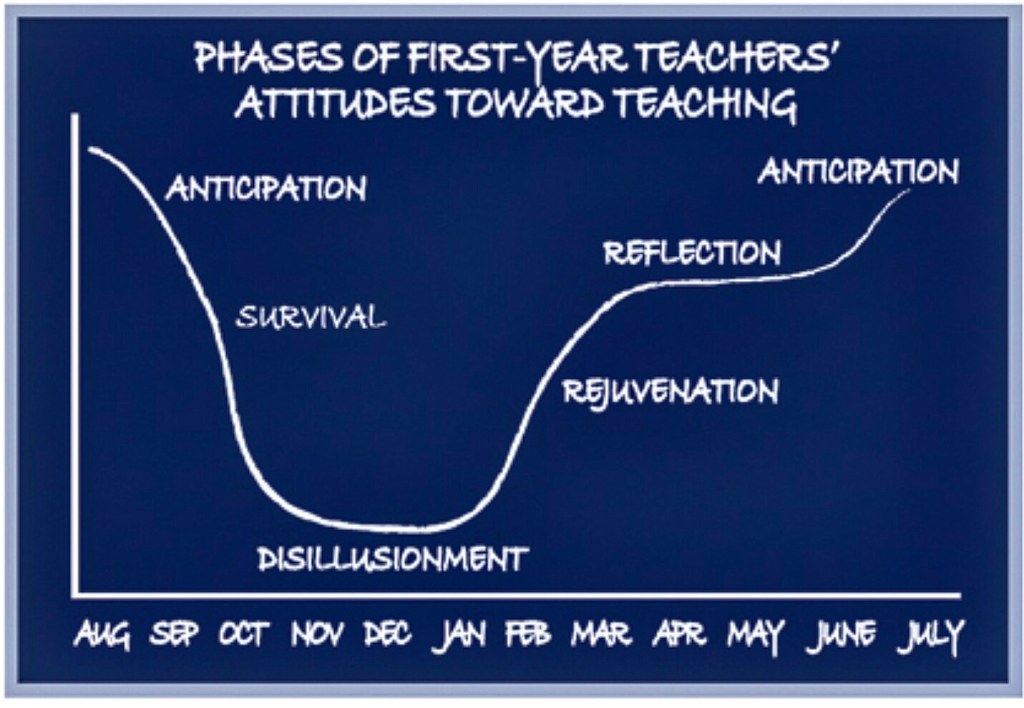
Then I remembered a little chart I came across last month, my friend and fellow teacher sent me a kind, encouraging open letter for first year teachers and in that letter it had the following graph (by Wisconsin Education Association) which is so far bang on the money.

To begin with it was exciting, the anticipation of applying everything I learned was off the charts and the first couple of months of teaching was all about survival, keep going, trying to plan amazing lessons in less time and improve whilst also having to do a million other things, but lately I feel sad and disappointed at times.
I’m not sure this is what I signed up for and I can’t but wonder whether this is for me, not just mentally but also physically. I guess the fact this is not my first job, I’ve lived and worked and led a different life plays a part. Perhaps this is just a phase. Some lessons are absolutely incredible, the students happily take part in most of the activities, they enjoy learning, I enjoy teaching them and time flies by, others there are so disappointing, disheartening, I don’t even want to be there.
It doesn’t help that I have very little free time to do other things not just work related e.g. lesson planning, if only I had more time to plan more engaging lessons, or time to read resources to help with my teaching and expand my knowledge but also just for myself: write, read, play my guitar, go for a walk, explore.
I’ll give it some time before I make a decision, maybe I’ll soon enter the ‘rejuvenation’ stage, but for now I just need to find the mental and physical strength to keep me going.
Who knows, maybe spending a few days in Barcelona, a city I’ve always wanted to visit, with my bestie who I haven’t seen for months, might do the trick and help me see things clearer.
Eleni