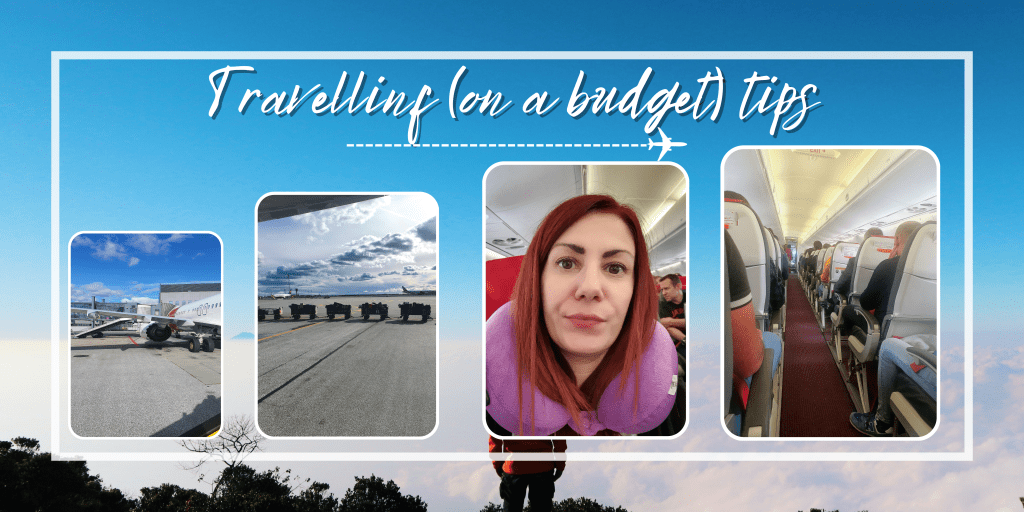
Travelling (on a budget) tips

A week ago I took my 12th and final flight for September. T-W-E-L-V-E flights in less than a month.

I love travelling and I’m experienced enough to know how to deal with most situations, but Oh.My.God the last month was exhausting, and challenging, to say the least ( in case you are wondering, it wasn’t by choice, I had to do it for work, so I was on a budget and I definitely did not select the flights myself).

I wish and hope I don’t have to go through something similar ever again, but in case someone else does, (or I need to do it again) here’s some tips from my experience and from lovely friends sharing theirs. Here we go:

Take as fewer flights as possible! Ok, it’s pretty self explanatory but the less time you spend on a plane the better. Sitting for hours and hours on a tight seat can affect your blod flow, which can cause swelling on your feet and ankles, the air on the plane is very dry, which can dehydrate you (see tip no2!) and dehydration combined with the lowered pressure of cabin air can cause fatigue, not to mention your ears popping and the increase of gas in your bowel. That’s why we get off the plane exhausted! These are just some of the negative effects of flying on the body, so the less time on air, the better.

Check roaming and call charges of your country destination/stop. I had no idea that mobile internet depending on the provider varied from 9 to 16 euros in Serbia and now I have to pay a 50 euros phone bill for the 10 minutes I used my phone, to let my family know I arrived safely, and that I manage to catch my connecting flight!

Hydrate! It’s surely not easy to stay hydrated when you run from plane to plane, having to throw away any liquids every time you go through security, but it’s probably the No1 thing to do to keep you going. Also, as we all know, airports are really expensive, so always keep an empty ,re-usable water bottle on you as some airports have water fountains where you can fill up your bottle for free e.g. in Vienna airport, they are located near the F and C Gates. I discovered a website that lists water fountains at airports, you can check it out before your flight! https://www.wateratairports.com/

Eat healthy. It’s tough, the majority of airports I’ve been don’t have a great selection of salads, soups or anything healthy, and the healthy snacks they might have are ridulously expensive (I paid 3 euros for a Kellogs bar, which is what it costs to buy a whole box of them from Lidl, and 2 euros for a banana!) so take as many healthy snacks and fruits as you can with you.

Always have painkillers and imodium on you. No need to expand on this one!

A travel pillow works miracles. It can help you nap more comfortable, especially if you struggle to fall asleep on a plane, like I do, and as a friend mentioned, you can also use it as luggage, filling it up with clothes!

– If stuck at an airport for a few hours go for long walks (you can check out the shops around, or move from cafe to cafe), don’t stay sitting for too long, your blood needs to circulate!

Get good quality, comfy, modular backpack. If you travel on a budget you will quite possibly have to carry a backpack for your essentials, and you will likely carry that backpack for hours on end, therefore it has to be big enough but also comfortable to wear, with additional cushioning on the back and the straps.

– If you book the tickets yourself and not booked through a travel agency, sign up for travel miles, they will come in handy at some point.

Look up the cost of food, transport, and living at your travel destination in advance. I had no idea Oslo was so expensive (5 euros for a small water bottle, the average price of a meal was 20-25 euros and most museum entrance fees were about 15 euros).

– When carrying luggage, find spots at train stations or bus stations where you can safely leave your bags and have a relaxed walk in the city.

– Some info points at airports provide city maps that have discount coupons.

– Finally, in between trips and when you are done travelling, take some time off to recover physically and mentally. The negative effects of flying time and sitting at airports on the body is just one aspect. The stress of getting from and to the airport (which sometimes it’s a bumpy bus or car ride or a long train ride), catching your connecting flight (especially when you only have 30 mins transit time to get to the next plane and you have to run like a mad person to the next gate), not having any time for yourself, missing your friends and loved ones, all this takes its toll on your mental health. So, spend as much time as you need to recover.

This is it from me and my friends, if you have any tips you’d like to share, leave a comment!

Eleni

My tips when booking flights in Corona times

At the moment I’m learning the hard way how incredibly, frustratingly difficult it is to book a flight out of Italy and hopefully back to Cyprus.

So I thought I’d share my top tips from my experience so far to help fellow travellers. I explain in detail on the video below but here are my top three tips:

  1. Check whether any flights you’ve already booked are still available on the airline’s website. If with Easyjet, be aware they mark flights as ‘sold out’ but in reality they are probably cancelled.
  2. Check refund policies. For Ryanair customers it make take up to a year to get their refund, if you manage to claim for refund as even when you do, Ryanair offers you a voucher and if you’d still like a refund, you have to speak to a customer assistant. Good luck with that. All lines and chats are occupied and you have to wait for hours. On the other hand, Easyjet claims they will refund you within 28 days and up to 90 days. Thousands of customers who had flights cancelled since March are still waiting for their money.
  3. Do not trust third-party companies. Check the airline’s page directly. Understandably with all the constant changes, sites such as Skyscanner are finding it difficult to keep up to date at all times and third-party companies e.g. Gogo gate offer flights which have been altered and don’t run anymore.

If you have any tips to add please comment, the more aware we all are, the better. It saves all of us money and trouble!

Eleni

How I got Grade A on my CELTA

Now in terms of possible outcomes, most students get a Pass, some get Grade B and very few (usually experienced teachers) get an A. I think you’ll do very well”, I remember Jonny telling me at my CELTA interview.

I had zero previous experience, I didn’t have much time to do any pre-reading and I hadn’t studied for anything for years, so I definitely did not expect or aimed for an A, but I somehow managed to do it.

Does it matter? You may ask.

Not really, I don’t think. It looks good on your CV and it seems to impress recruiters (at least the ones I’ve had interviews with so far), so it might give you a slight advantage, especially if you are newly qualified as I am, but as long as you have the CELTA, the grade doesn’t really matter. It’s tough enough getting the qualification and everyone who has done it knows that!

How did you do it? One might wonder.

Surprise, surprise, there is no recipe. Even if I were to describe you in every single detail what I did, I bet you it wouldn’t work for everyone. So unfortunately I can’t do that. What I can give you is some guidelines and advice to help you achieve an A (no guarantees) based on my experience.

  1. Avoid distractions. Do the full-time variant and away from home if you can. It helps if all you concentrate on is the CELTA. It’s exhausting, physically and mentally but I functioned significantly better focusing only on my course. For me the course actually helped as a distraction from dealing with the sudden death of my grandpa and other life situations.
  2. Listen to your tutors. It’s a no-brainer really. But listen carefully, take in as much as physically possible and actively take part during input sessions. I was craving for a challenge after years in a repetitive, dull job and my brain worked like a sponge and I followed their instructions and guidance religiously.
  3. Work on the feedback your tutors and classmates give you on your teaching. Probably the most important one. Every single time I took their suggestions and feedback on board and I improved after every Teaching Practice (TP).
  4. Help each other. OK, this you can’t control. Your classmates might not be that friendly or helpful but our group was pretty amazing. We helped each other with everything, checking each other’s handouts, reading each other’s assignments, even little things like getting coffee for each other. I wouldn’t have done it without them. Honestly.
  5. Trust yourself. This is a tough one, but in order to get Grade A you need to demonstrate you can work independently, plan and deliver a lesson with minimal guidance (for the last two TPs the only ‘guidance’ I got was nodding). When Fiona, during our second tutoring session, asked me why I was being ‘modest’ when scoring myself as ‘to standard’ for most and a couple of ‘below standard’ of a long list of competences (the ones you are being assessed on your CELTA), I wasn’t really being modest. I thought I was doing OK but I didn’t really believe I was ‘above standard’. I didn’t know what the standard was so I had no idea how I was doing. After that session I did my best, not because I was desperate to get Grade A, but not to let Fiona and Jonny down, who believed in me and gave me the chance to go for a higher grade. I didn’t care about the grade, I cared about them, so I had to believe in and trust myself, particularly for those last two TPs.
  6. Pay attention to detail. Don’t rush into doing your assignments or planning a lesson. Do it carefully and take everything you learn into account. Otherwise you won’t produce quality work and I promise you, you will have to resubmit at least one or two assignments. The reason I didn’t have to resubmit any was due to my overthinking and excruciatingly painful need to keep working and working on something (and probably all the years of studying at uni). Thank God for deadlines.
  7. Be creative. With your lesson plans, your handouts, your PPTs. If you just follow the book to every single detail and not improvise, use other resources, design your own exercises, not only you won’t get an A, you won’t make a great teacher either.
  8. Get to know your students, keep them engaged and interested. You can design the best, most fun, amazing lessons in the world but it means nothing unless you deliver them well. How? Learn your students’ names and personalities, use their first names, ‘read’ the situation, if they look bored or disinterested or baffled, change your lesson plan. For me it was easy, I love chatting to people, getting to know them and I’m good at observing and noticing others reactions. If you don’t care about your students you won’t last long in this job!

So these are my top 8 tips, based on my experience. Some of it may not be easy to follow, not everyone finds it easy to be creative, perceptive (that’s down to personality) or write an assignment (that’s down to experience and I had plenty in academia) and you may not get Grade A even if you follow my advice, but I promise you, you will at least get the most out of this uniquely painful, rewarding and at points surreal experience.

Eleni

How I survive work in a dead end job.

Happy Sunday! I was going to post this tomorrow but I thought it’d be better to do it today, in case my survival techniques can make your Monday better, if you are in a similar situation.

I wanted to write about this for a while although I was advised not to, because it might cause problems at work. But it shouldn’t. I hope it won’t.

I love Solent, it has been my work family home for almost 6 years now (with a short 3 month break). I’ve learned a lot and I made friends for life. This is not about Solent. Although ideally I’d like to work somewhere else for a change, Solent is an awesome employer and I love the people I work with.

This is about being trapped in a dead end job, with no progression and is not even about progression, but the tasks, my day to day roles and responsibilities which are de-motivating. For me anyway. I’m sure for others, my job would be a perfect fit.  So this post is about how I deal with it and hopefully you who are reading this right now might benefit from it.

My job

Not many know exactly what I do when I tell them I’m a Senior Compliance Officer. Well first of all, is nothing to do with Compliance. I co-ordinate the fees process working with some of our Directors who I admire and I’m responsible for the course file, basically anything to do with the course set up on the system. I spend most of my day in front of my PC, staring at spreadsheets and Quercus (the course system). Which I find quite frankly soul-destroying. There is no skill variety or challenge. I’m a social person, I love chatting, meeting people, I love anything creative, anything out of the norm and I hate routine. Is obvious I’m not the best fit for an 8-hour a day desk based job.

I have great responsibilities which I honour day in and day out. Because as much as I don’t enjoy what I do, I always want to be the best at my job. I’ve been in this role for two years now and I don’t think I’m exaggerating to say that I’ve already improved the processes and the system.

‘A job is just a job’

For many their work is just means to an end. They don’t care what they do and how they do it, it just pays the bills. And that’s great. But unfortunately for me is more than that. We spend most of our time at work. We spend more time at work rather than anywhere else. So for me, it has to be rewarding, challenging, interesting. It has to be more. I cannot numb my brain and switch off for 8 hours.

‘Why don’t you leave?

I’ve recently listened to a podcast of Bob Sutton, a Stanford professor and author of the ‘Asshole Survival Guide’ on how to deal with difficult people at work. His tips can easily apply to ‘Work Survival’ in general, His first advice was: If you can afford it, leave. If you can, quit!

I hear that a lot. Many have advised me to do so. Quit. Follow your dreams. Don’t be scared. Take risks!

Well it’s not that simple. I can’t just quit. I have no savings, I’m still paying off my debts and my family can’t support me financially. And I wouldn’t even ask them if they could. This is my fight. I love them to bits and I’d do anything to help them, not the other way around.

I could just move back home, live with my parents for a while until I get an average job, as there are not many great career opportunities on a gorgeous but small island. So that’s out of the question.

If I were to quit I’d have to move to another data analysis/staring at spreadsheets job to be able to cope financially, which is not what I want.

So what do I do??

Learn as much as you can on what you want to do.

I love digital marketing, Social Media, event planning, guest relations, anything to do with interacting with others, but I have no extensive ‘work experience’ in these areas. I would need to start from the bottom and to do so I need money. Money doesn’t bring happiness but it does help you reach the things that will make you happy.

But what I do at the moment is spend some of my free time learning more about the fields I’m interested in and improving my knowledge on them. Lynda.com is amazing when it comes to free resources (it is free for Solent employees) and I’ve already learned a lot in the last couple of months.

I also volunteer through work whenever I get the chance. I loved helping out with Graduation, conferences, getting out of the office and meeting new people.

So that’s my first tip. If you are in a similar situation use your free time to your benefit and try and get as much as you can through your current role. Learn more on what you want to go into.

Humour

It is vital to have a laugh at work, within reason of course. But short breaks to talk to my colleagues and have a laugh is one of the few things that keeps me going. I’m very lucky I’m surrounded by funny, witty colleagues who are always up for a chat and a laugh.  Humour is also recommended by Bob Sutton when dealing with difficult people at work.

Make your desk your own

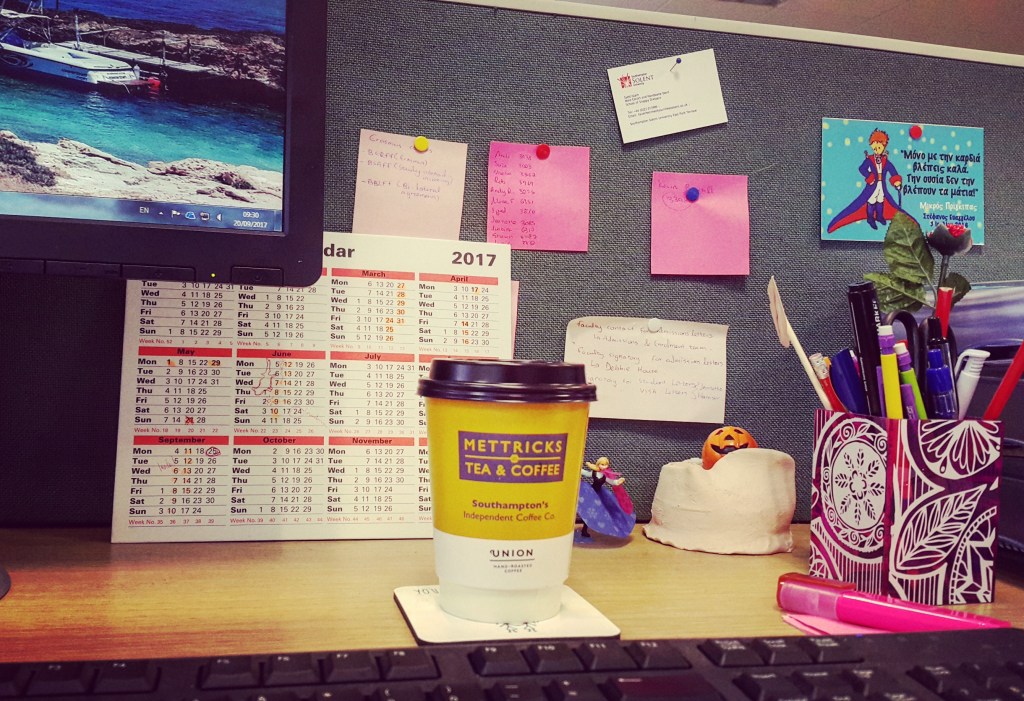
I’ve decorated my desk with memorabilia from home, gifts from colleagues and friends, Kinder Egg prizes because I embrace my childish side and I set up a gorgeous photo of my favourite Cyprus beach I took a year ago as my PC wallpaper. Anything that makes my surroundings colourful and pretty and reminds me of who I am helps. You spend most of your time at your desk, might as well make it feel homely, even if you wish you were anywhere else.

Music

Music is my saviour. It really is. I would simply not survive if I were not allowed to stick my headphones on and listen to music. I absolutely love Spotify and I’d pay more if I had to. Discover Weekly on Mondays, New Music Fridays and my personal long playlist with all my favourites for all moods which I go through several times a day depending on what I fancy to listen to at that moment. This is my playlist, which I add on every week if you want to listen to what I listen to, it has a little bit of everything, from indie to pop to rock to Greek music, not sure anyone else would like it, but even if it helps one person, then totally worth sharing it.

Regular breaks

If you sit at a desk all day, have short breaks every hour or so. It is recommended by Health and Safety! Get off your chair, go for a walk or just stand. And don’t spend your lunchtime at your desk. Make time to get out even if it’s in another room or a friend’s office or go for a wander at the nearest park. Lunch time is sacred, is you time, personal time, use it wisely.

Treat yourself

Every now and then I’ll treat myself to delicious coffee from my two favourite coffeeshops in town, Mettricks or Coffeelab or a nice lunch or an afternoon snack. Little treats go a long way!

Break the routine

There are many ways to do that, be creative. For me is essential to do something different every day, otherwise it feels like Groundhog day, over and over again. So I have lunch at different places through the week, I change my route to and from to work every couple of days, I try and do a couple of different tasks at work in a single day and not spend the whole day on just one thing, unless I have to.

Do what you love when you are not at work

Finally, what keeps me sane is what I do when I’m not at work. Find what makes you happy, what relaxes you, what you love and spend your evenings and weekends, however tired, drained or frustrated you might feel, doing these things.

For me is daily Yoga (Yoga with Adriene, which I’ve mentioned many a times here), my guitar, singing, blogging, drawing, reading, eating out, theatre, trying new things, photography, travelling and social media amongst others.

I love Instagram, I spend hours scrolling through travel photos, food (I love food), interior decoration, funny memes etc and I post a lot because I love taking photos. Twitter is my public journal. I follow and learn from inspirational people on LinkedIn and Facebook is for friends and family.

I spend a lot of time with my bestie (our daily chats is therapy for me) and other friends I love and since my family and best friends live in Cyprus, you’ll see me a lot of the time on my phone chatting to them.

Don’t forget how awesome you are

Yes, that’s right. You are awesome. When you are trapped in a dead-end job, the chances are you are scared to move on even when you can, because you lose your confidence, you forget all the skills and knowledge you proudly own. When I left Solent the first time, my then manager and now great friend Chris wrote on my leaving card not to forget how awesome I am at what I do and be confident on my abilities and I go back and read it whenever I go through a confidence crisis. I remind myself what Chris said and all the feedback I get from my current manager and my colleagues. I go through the messages and comments I get on my blog and Social Media posts and when I’m feeling low I remind myself that I’m better than I think.

This is how I manage. This is how I keep going until I can move on to a more exciting job.

Nobody will come out of nowhere and offer me my dream job, although that would be pretty awesome, so for now I’m exercising my patience and improving myself whilst keeping my eyes open for any opportunities I can go for.

Namaste

Eleni