The historical ‘Ohi’ (No) day

Today is a bank holiday in Cyprus and Greece.

Not many know why. I’m not sure what went wrong with the educational system since my generation left school.

We were not just aware of what we celebrated on each national holiday, we knew details, the nitty gritty.

So, what do we celebrate on the 28th of October?

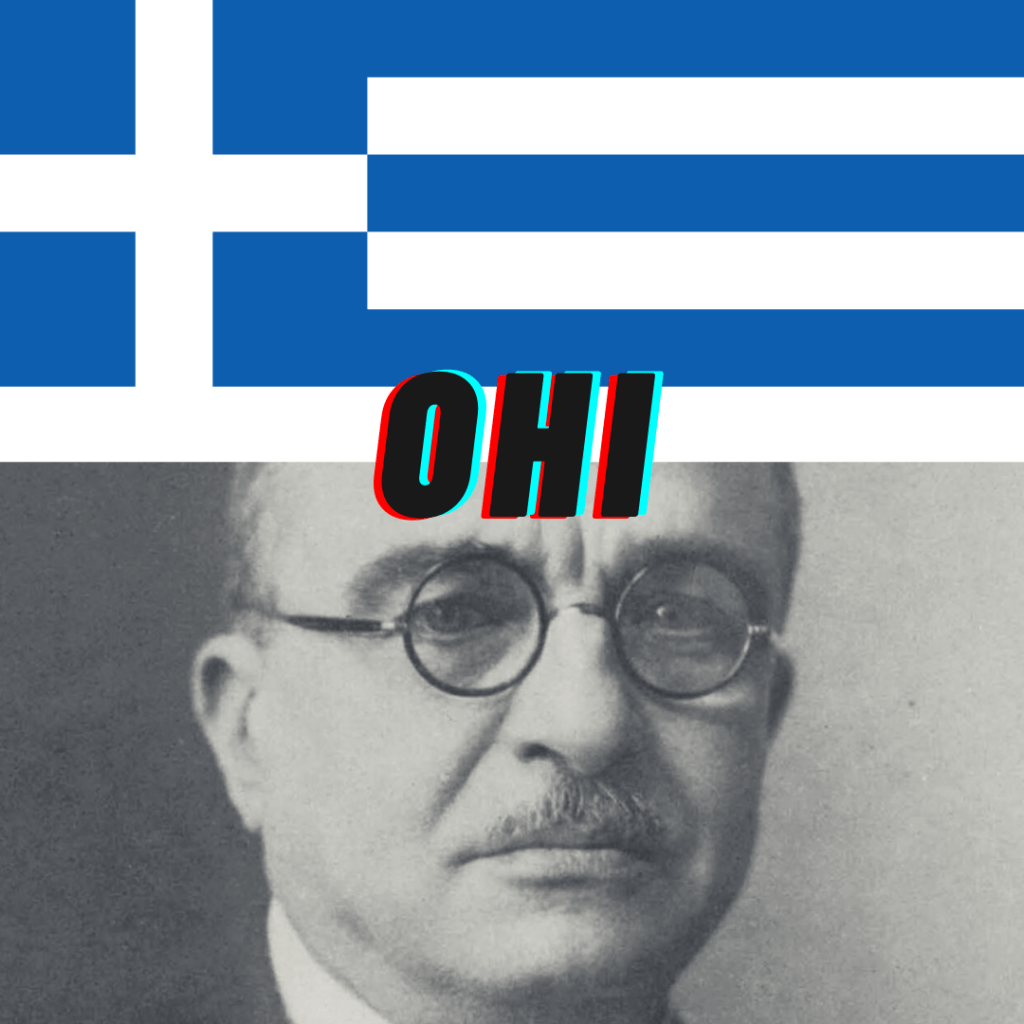
On this day, in 1940, 80 years ago the Greek dictator and Prime Minister Ioannis Metaxas (we were not taught he was a dictator until we were 15-16, before then we grew up to think of him as a national hero) said the historical NO to the Italian ambassador in Athens, Emanuele Grazzi, when he presented Metaxas with an ultimatum, either allow Italy to enter Greece and occupy strategic locations (so Italy can conquer more countries during World War II) or face war.

Apparently Ioannis Metaxas’ immediate response was actually in French, the official diplomatic language, “Alors, c’est la guerre!” (Then it is war!). He then used the historic phrase NO when the Italian ambassador tried to persuade him to change his mind. (This part I couldn’t remember, I admit).

After Ioannis Metaxas’s rejection of the ultimatum, Italy invaded Greece and that was the start of the Greek-Italian war of 1940-41 in which the Greeks fought heroically and actually managed to keep the Italians away until Germany came to the rescue and then Greece were under German occupation until the end of World War II.

It just goes to show that the power of the spirit and soul is undefeatable and historically we humans always seek our freedom and we will fight to death for it. Sometimes we forget this.

But we shouldn’t. We should always fight for our freedom, in any form or shape, financial, spiritual, physical.

Anyway, here’s to the 28th of October and the historical ‘Ohi’.

Eleni

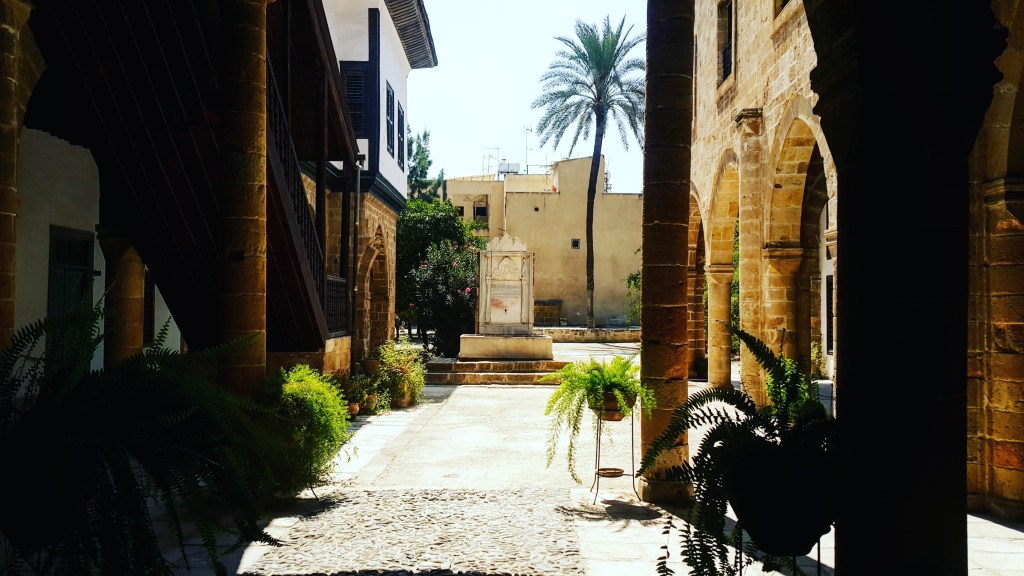
The Hadjigeorgakis Kornesios Mansion

September 5th, 2018

It’s a hot, sunny day.  Somehow is already 12pm and I’m wandering in Old Nicosia, sweat dripping down my back, my head so hot it physically hurts and miraculously mum and Stella are going along with it but the little sister is complaining ‘Why did we have to come today, the hottest time of the day? For what? Just to see a house?’

It’s not just a house. You don’t understand. It’s a piece of Cypriot history and it’s the most gorgeous house I’ve ever seen. Probably my favourite historic building in Nicosia, no, not just in Nicosia, the whole island!

‘You’ll see when we get there. Come on, keep going and stop whinging!’

And finally, here we are.  The Hadjigeorgakis Kornesios Mansion, or Konaki (Konak: Turkish for official residence, back in Ottoman Empire times). ‘The most important example of urban architecture of the last century of Ottoman rule that survives in old Nicosia’. So who was Hadjigeorgakis Kornesios?

He was a dragoman, an official interpreter for the Divan (Council) of the Sultan in 18th Century Cyprus, when the island was under the Ottoman empire, mainly dealing with taxation and administration. A wealthy, high-esteemed man who used his power and money to secretly help and protect Christians, lepers and the Church of Cyprus, which caused the hatred and envy of the Turk Officials who decapitated him in Constantinople in 1809.

I  can’t recall how old I was when I was last there, it was on a school trip sometime in high school but I still vividly remember that feeling of pure awe of the beautiful yard, every single room, especially the ‘living room’ where Kornesios entertained his guests.

As soon as you walk in the huge dark brown doors you can’t but admire the beautiful terrace, the imposing pillars, the beautiful trees.


The inside is equally impressive. The furniture, the ornaments, the architecture. How not to love this place.


I could just imagine how life might have been in the 1800s, Kornesios having breakfast with his wife and children on the sunny terrace,  how they would secretly meet with Christians on a dark summer evening and the next day he would be smoking shisha with Turkish Officials.

I was so happy I managed to visit this place again after so many years, now as a ‘mature’ adult. It was exactly as I remembered it, time hasn’t changed it at all, but now it somehow felt more sacred. I guess because I could appreciate its importance now.

After our visit, we headed to Shakolas Observatory for some panoramic Nicosia views. It’s always bittersweet witnessing the contrast, looking over to the ‘other side’. Such a beautiful city but divided, ‘the last divided capital in the world’.

Nicosia

It was late lunchtime by the time we were done so we sat at a nearby Cafe La Mode (I know, so many choices, why sit at a chain restaurant, but the majority won) for a cold Jasmine tea and a veggie wrap. It was delicious, I must admit.

Cafe La Mode

If you ever find yourself in old Nicosia, go, see the Hadjigeorgakis Kornesios with your own eyes, you won’t regret it.

Anna I hope you get it now!

Eleni


05:30, 20th of July, 1974 the sirens sounded, the Turks just invaded Cyprus…

43 years agο, on the early, warm morning of the 20th of July 1974, the sirens sounded. Since then they will sound every year on that day to remind us of 1974.

My mum, 8 years old then, with two of her three sisters, her brother and her parents woke up terrified and were told that Turks invaded Cyprus and had to leave their home and ran into safety. Her eldest sister was with her grandma and grandpa, captured by the Turks. Later on a kind Turkish officer would disguise her and she would pretend to be an old lady so she could escape and avoid rape and murder…

A few cities away, my dad, his two sisters and his mum were on the run, desperate to get into safety… They would live in a refugee camp for months…

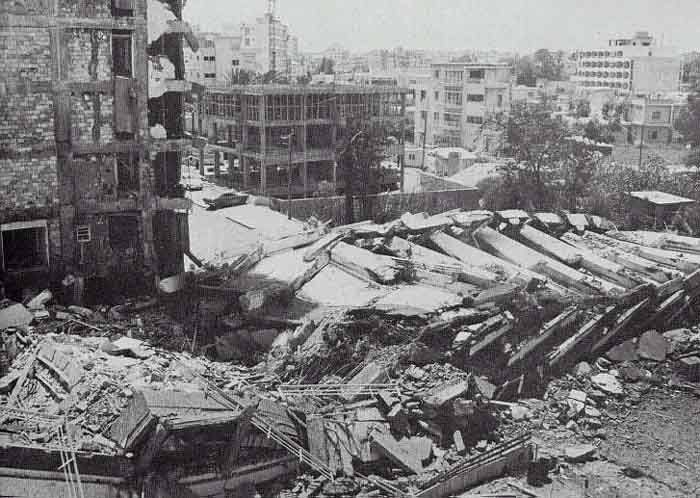
My dad still has some photos from the time he lived in those but since they are all back home in Cyprus. I found these ones online, to give you an idea of life after the invasion.

I’ve heard and read hundreds of horror stories over the years, not just what I’ve been taught at school (not much) but from my parents, relatives, family friends and my own research.

I spent endless summer nights with my dad sitting on our balcony, having a cold beer and him narrating everything that has happened with chilling details, from the 15th of July 1974, the coup, the assassination attempt of the then president Archbishop Makarios (his statue is still in Madam Tussauds), the historic moment he addressed the Cypriot nation on the radio confirming he was alive, until that horrendous day, 20/7/1974 that left a horrible mark on my little island’s history for ever.

43 years later, a lot of people are still missing, several have died in protest (I vividly remember the summer of 1996, when Solomos Solomou, upset and emotional after his cousin’s murder, was shot dead by a Turkish officer, whilst climbing on the flag pole in an attempt to take down the Turkish flag and replace it with the Cypriot one. The whole island watching this were terrified that the Turks would invade Cyprus again, I had nightmares for years after that day)  and Nicosia is the last divided capital in the world.

I won’t get into too much politics but I’m aware that England, Turkey and Greece had already divided the island since 1963, 11 years before the invasion and the infamous Green Line that still divides my little island got its name from the colour of the pen the then British Commander Young used to split the island on the map. British forces are still in Cyprus to keep the ‘peace’ between the two ‘governments’.

It’s sad that after all these years the island is still divided and all because of politics. My grandparents and parents used to live with Turkish Cypriots in peace until politics destroyed everything. My grandpa can still speak Turkish, as he had Turkish Cypriot friends.

It’s sad that my little sister’s generation doesn’t really know much about what happened and a lot of the memories and the history will die when my generation dies.

I remember my dearest grandma Stella describing me the beauties of her birth place, Kithrea, the river that run through it, Kefalovriso, how my mum used to play with the ducks in the river, my grandpa telling me all about his life before 1974, being a shepherd, spending his days in the fields, playing his flute. I remember my dad’s hilarious childhood adventures, running around getting himself into trouble, working at his uncle’s restaurant and many many more stories.

I’ve always wanted to write them down so they don’t die with me and that’s on my bucket list.

I can keep on writing about my little island’s history for days but the only thing I want to say on this day is:

I hope that one day I don’t have to show my passport to visit my mum and dad’s homes, the places they were born and grew up. I’ve only visited once and I found it extremely sad and felt sorry for Turkish Cypriots who most live in poverty. There is so much beauty on the other side of my island but no money to let it shine through.

I hope one day my little island will be united again, even if it’s under two governments.

Until then, I’ll never forget and hope for the best.

Δεν ξεχνώ και αγωνίζομαι.

Eleni x