Living in Italy in the time of Coronavirus: the lockdown diaries

Wow. Just wow. I will always remember the last couple of weeks in every single detail.

Within 10 days, all schools in Italy closed until the 15th of March and after just 4 days that was extended to the 3rd of April, oh and the whole country was to go under lockdown.

What did that mean? A lot of things. How am I dealing with the situation? So far I’ve just been stressed and worried and baffled (how on earth on my first year after quitting my job to travel the world ended up trapped inside four walls?) but I decided to make the most out of it.

My friends and family, even strangers have been asking me how things are here, so I’ve put together a vlog, the first one of a series, documenting living and teaching under lockdown conditions so here it is:

I will soon post more on teaching online from home, coping mechanisms (healthy and unhealthy) and how my mental health has been affected by it. I hope you find it useful!

Oh and somehow I ended up speaking on the radio about it twice, once to BBC World Service before the lockdown and once after with my friend Pat at BBC Radio Solent!

https://www.bbc.co.uk/programmes/p085vz18

https://www.bbc.co.uk/programmes/p082yvg6 (10:26) and full interview here: https://drive.google.com/file/d/1IE4OuoBngbN6unQIV9AKgw1qOS-g2-Ur/view

It has been challenging so far but my personal advice is please stay at home, avoid travelling internationally, avoid confined spaces, restaurants, churches, cafes, work from home and help to put a stop on the virus spreading. It will continue to spread if people continue to move about. It’s tough but necessary.

And please follow the WHO guidelines, wash your hands thoroughly and avoid handshakes (that’s how the virus is mainly transmitted, by touching others or contaminated surfaces), cover your mouth when sneezing and coughing, do not wear a mask unless you have symptoms or you have an underlying condition that it requires you to do so, AND STOP PANIC BUYING TOILET ROLL!!

Anyway, until next time, keep safe.

Namaste

Eleni

5 minutes of mindfulness

About two and a half years ago I went to a talk on recognising signs of mental health problems, by Hugh Clarke, the Former Head of Counselling services at London Met University and counselling Psychologist.

It was a brilliant talk (you can read about it here), informative, thought-provoking, we chatted about it for a while afterwards. I still remember how it started, a 5 minute mindfulness activity guided by Mr Clarke. I absolutely loved it and everyone in the room seemed to have enjoyed it too. No surprise there of course. Mindfulness (focusing in the present moment, whilst accepting one’s feelings, thoughts and body sensations, in a nutshell) has been scientifically proven to alleviate anxiety, reduce rumination, improve attention, manage chronic pain amongst many many other benefits .

A lot of people are sceptical, I was initially too. I had tried to practise mindfulness myself before that day but I found it incredibly hard to focus (my overthinking brain struggles to concentrate on just one thing at a time) and ‘aids’ I discovered (e.g. apps), made me giggle, perhaps too cheesy for me. But Hugh’s 5 minute guided exercise completely changed my mind. It wasn’t cheesy, funny, or superficial. It worked fine and by the time we were done I forgot about everything else and my whole attention was turned to the session. It was just perfect.

Fast forward to about a month ago, Nour and I were thinking of ideas on how to start our presentation for our ‘Survival Guide for New EFL teachers’ session and then I had an epiphany. Hugh’s mindfulness opening activity was so effective I still remembered it after all this time, and we all, especially newly qualified teachers desperately need to be able to focus in the moment, do one thing at a time instead of trying to multitask and failing miserably, so why not start our session by giving our audience 5 minutes to relax and forget about anything else?

So, I found a 5 minute mindfulness activity online, similar to Hugh’s but the language used was too ‘formal’ and frankly tacky, so I created my own using my personal experience and a mixture of Hugh’s activity and the ones I found online (I may have borrowed some beloved expressions from Yoga with Adriene). I thought I’d share it in case others would like to use it. A colleague suggested I made a video (for those that may want to try it on themselves) and I would love to but that takes time so for now here’s the instructions (remember to take your time with each step, check your participants’ reactions and act accordingly):

  1. First, sit comfortably on your chair. Close your eyes and relax your shoulders. Place your feet on the floor, if comfortable, your entire soles touching the ground. If you want to giggle, then feel free to do so!
  2. Take a long deep breath (take a deep breath yourself). Now let’s focus on your toes. Wiggle them, feel them, then curl them really tight. Keep curling…. and release. Take another deep breath.
  3. Now move up to your ankles. Again, notice how they feel (pause) and now move on to your knees. Do they feel tense? If so, relax.
  4. Any thoughts that may come up in your mind e.g. what you are doing after this, what you are having for dinner, imagine they are in a bubble and let them float away. Take a deep breath.
  5. Now relax your bottom (pause), your pelvis (pause) and then begin to notice any tension you may have on your back. Take another deep breath.
  6. Now focus on your shoulders. How do they feel? Now lift them up, lift, lift, lift and…. release. Wonderful. Take another breath.
  7. Now relax your neck, gently twist your head left to right and let any tension go.
  8. Now focus on your jaw. Is it tense? Are you clenching? If so, relax your jaw muscles and take a deep breath.
  9. Finally focus on the top your head. Notice if you are frowning, we often do without realising, and relax your eye brows.
  10. Now lift your shoulders once more, lift, lift, lift…. and release. Let any remaining tension go.
  11. Now focus your attention on what’s happening in the room. Notice any sounds you can hear, any smells…
  12. Take one last deep breath… and open your eyes. How are you feeling now?

Survival guide for new EFL teachers

When we were asked by one of the DoS (Director of Studies) whether we’d like to present at the IH South Italy conference, although I was overwhelmed with all the additional work I took up on top of teaching (putting together promo videos and planning events, which I absolutely love but God it takes time) and barely had time to do anything else, I really wanted to.

I’ve never presented at a conference before. Sure I gave presentations at work and uni, but never at a conference.

‘But what can I talk about? I’ve only been teaching for two months, what can others learn from my experience?’

Most of the days I’ve been over stressed, overworked, overwhelmed, wondering whether I’m doing this well, if my students are really learning and whether all this it’s worth the anxiety, the lack of me-time, of any time to do anything else other than work. If you are a newly qualified teacher you probably nodding your head reading this.

And that’s when I had a light bulb moment. What if I put together a ‘survival guide’ for newly qualified English teachers using the wisdom of existing teachers? I’ve already learned a lot from my manager, our DoS and fellow teachers in the couple of months I’ve been working as an EFL teacher, so imagine gathering all these little nuggets of advice and summarising them into a couple of pages?

I asked James (one of our DoS and the kindest man on earth) if he thought that would be a good idea and he seemed to like it. It’s hard to tell if he really liked it or he was just being polite as he always is but I thought ‘Let’s do it’, I might not get the chance again, who knows where I’d be and what I’d be doing next.

I asked around the room if anyone wanted to present with me, not that I was shy presenting on my own, but there are a lot of NQTs in our school and it would be a good opportunity for someone if they’d like to present. One of my fellow teachers wanted to present with me and to cut a long story short I set up a survey, sent it to teachers we knew and posted it on FB groups and got around 40 responses in just two weeks. Time management is a huge issue for new EFL teachers!

We gave the presentation at the IH South Italy conference yesterday, summarising and demonstrating some of the most common advice on topics we, newly qualified EFL teachers struggle with the most, and I thought I’d share it here too, to hopefully help other newly qualified teachers who may be struggling.

The CELTA can’t prepare you for what’s about to happen when you start teaching children or large classes or full time (also forget CELTA lesson planning time when you start teaching 4-5 hours a day!) so if you need any ideas on how to reduce your lesson planning time and manage your time better in general, or what you can do to help you with teaching young learners, or how to look after your mental health and wellbeing, have a read below.

What I’ve learned so far and I’d advise others (which most teachers recommended in the survey):

-Always have pre-prepared, low resource activities in hand (see ideas below) or lesson plans you have already prepared (start building your own archive), so if you hadn’t had time to plan in detail or ran out of material you can still have a great lesson.

– Plan less, don’t spend hours on it. Most of the time you can’t afford to spend hours. Not every lesson has to be amazing with heavy resource and planning activities. Use the coursebook and extend/adapt some of the exercises, students will still enjoy it (though it is more fun not using the book, especially if the material is not engaging for the students).

-Ask for help. We all regardless of experience give each other ideas and we all help each other with little and not so little things. And if you are struggling, talk to someone!

-Make time for yourself, your hobbies, your passions. Teaching shouldn’t take over your whole life. There is is much more in life than work.

-Making a mistake is not the end of the world. In fact that’s how you learn!

-Look after yourself. Rest, have breaks, sleep. At the end of the day teaching is just a job. If you don’t enjoy what you are doing/ you are too tired/ drained it not only affects your teaching but it’s not worth doing if it compromises your mental and physical health.

(the session started with a 5 minute mindfulness activity I’ll share on another post and also included demonstrations of a classroom routine, giving clear graded instructions, planning an activity for a lesson in a few minutes-yes, it’s definitely do-able- and finished with the audience getting to know each other outside their teacher remit and catching up with friends they haven’t messaged in a while).

Feel free to share and spread the wisdom. The survey is still open if you’d like to share yours. I thought instead of closing it, try to get as many teachers filling it in with their own ideas and advice instead (https://forms.gle/7wqyKbtQ789jVLeu9).

Thank you to everyone who filled in the survey, my co-presenter Nour, my lovely colleagues Maria and Mariah for their super useful feedback and ideas and a very special thank you to James who not only advised and helped me with the survey and PPT from the beginning, even during the Christmas holidays but also for his encouragement and mental support. He even saw the session twice. What a man.

Eleni

Things no one tells you before you move to (southern) Italy.

Pizza, cheese and wine every day, wandering on little cobble streets, gelato for lunch, pasta for dinner, music everywhere, slow and relaxed life, Italians are never in a rush, everything is easy. The Italian dream. That’s how most imagine living in Italy is like. But is it really?

I’ve been living at Reggio Calabria, a small town down at the bottom of the Italian ‘boot’ for over a month now and let me tell you what I’ve learned so far.

Settling in

Bureaucracy

Oh my lord I thought bureaucracy was awful in Cyprus after I’ve lived in the UK for 10 years, but so far Italy is the winner by a mile.

Setting up a bank account is a nightmare, especially if you don’t have a permanent address or if you do but it doesn’t ‘match’ your nationality.

First of all, you need a translator as nobody speaks English (more on that later), then you have to physically go to the bank, which still happens nowadays (although with most large banks you can set up an account online, at least in the UK), so fair enough. But, be prepared.

In order to open an Italian bank account you need a ‘fiscal code’ first (the equivalent to the NI number in the UK). To get that fiscal code you have to fill in a form and apply, in person of course, at ‘Agenzia delle Entrate’ (Italian tax office). Therefore first step: Get the fiscal code (then an Italian phone number, -see reason below-, and then go to the bank to open an account). You will also need some official documentation (if there’s a mismatch between your address and nationality) stating your NI number.

Also, it’s highly recommended to get an Italian phone number before you get an account. The bank I’m with will send you your PIN through SMS for free OR you have to pay an additional 5 euros (to the 23 euros fee to set up the account) to send it to you through the post.

Bear in mind that for some providers e.g. TIM it takes 24 hours for the sim card to be activated, so I’d suggest getting the SIM card a few days before you head to the bank in case something goes wrong (which can easily happen).

Sorting out the internet is not straight forward I found. The flat I live in doesn’t have a router, I don’t even know if it has a landline set up. The only option was mobile internet. I got a MiFi device (mobile wi-fi) for 40 euros and a data SIM card, 14,99 for 50 GB a month. So far so good, though TIM customer service is not the best, topping up after the first month didn’t work and I was overcharged and when I asked for a refund I was asked to send a fax (we live in 2019 for God’s sake, who uses fax?).

Living

Non parlo Italiano. The most common phrase I’ve used so far. Living in a small Italian town has its perks but also means that very few people, even in shops, speak English. My advice: learn Italian as soon as physically possible. (PS TV is also in Italian, everything is dubbed, thank God for Netflix).

Renting is cheap compared to other Italian cities (I pay 450 euros for rent plus electricity and gas), though salaries are generally low. Financially it would have been much better to share, but I’m too old and fussy.

Rubbish collection, when, what, how? In a huge contrast to bureaucracy and archaic systems in place, (as well as horrendous traffic) Southern Italians are keen on recycling, which is awesome, though ever so confusing. Some days are only for organic/food waste collection, others paper and cartons, then multimateriale (cans, plastic etc) and indifferenziato (still unsure what that is) and each bin it’s a different colour. It took me a while to get used to it and remember to regularly check the schedule.

Local cuisine is as great as you’d expect. I don’t have much free time as you might be aware if you read my previous post on the life of a newly qualified EFL teacher, but so far I’ve tried the local pizza and Sicilian arancino and canoli. De-li-cious.

Food shopping can be expensive, if you don’t live near a Lidl. I pay more than I thought I would on groceries and some things you’d find for a pound or less in the UK (or Cyprus) you pay 3-4 euros here e.g. baked beans.

Amazon Italia is not as good as Amazon UK. Most products are more expensive than expected and the range is limited compared to Amazon UK.

The Chinese shop is the place to go for a rather random but large selection of affordable items from Christmas decorations to stationery.

What dance/yoga/art… lessons are you talking about? I’m not sure if this is due to location or the size of the town but for whatever reason, other than shopping and an escape room I recently discovered there’s not too much to do in the city in terms of hobbies, not that I have time anyway, but I’d love to have the option. Plenty though outside the city (or if you take the ferry to Sicily). If only driving was easy in this crazy country!

Drugs are ridiculously expensive. I paid 14 euros for Nurofen Cold and Flu!! I had no idea that you can get the same drugs but ‘unbranded’ cheaper. Of course pharmacists avoid telling you that so you buy the most expensive ones, so make sure you ask for Tachiflu instead or Tachipirina (paracetamol) or take some essentials with you.

Public transport is not the best around here, so be prepared to walk,-don’t even think about cycling, even if the town was not that hilly, you will almost certainly be hit by a car-, or if you drive you’ll have to get used to risking your life daily getting hit by another car and endless hours stuck in traffic-. Italians are infamous for their terrible driving and that is actually very true. Please remember, very rarely cars stop at crossings, check carefully before you even attempt to step on the street.

What else?

Other little things I discovered:

Certain cities e.g. Palermo (where I stayed for two nights) charge City Tax for hotel stays, 1-3 euros per person per night depending on hotel stars.

Haircuts are dirt cheap. I paid 12 euros for a decent haircut.

Some things are difficult and/or expensive to find in a small Italian town e.g. kettle, Chocolate Digestives, avocados, WHERE THE HELL ARE THE AVOCADOS?e

Italian time is similar to Cypriot time ie noone is in any rush, expect delays to the hairdresser, supermarket, meetings, I won’t even comment on post etc.

People are a bit nosy and loud but quite friendly, caring and always offer to help, which I love. Some of the kids in my classes, although they only know me for a month, they give me a hug every time after each lesson, one girl drew a little sketch of me and I had plenty of fun conversations and laughter with my older students.

All in all it’s been a mixed bag so far but I love the experience, getting to know a city by living in it. I’ve only been here for two months, I’m sure I’ll find out more as time goes by and when I do I’ll post an update.

I hope this might help anyone considering moving to Southern Italy. Feel free to share your experience on the comments, I’d love to hear how it’s been for others!

Eleni

How I got Grade A on my CELTA

Now in terms of possible outcomes, most students get a Pass, some get Grade B and very few (usually experienced teachers) get an A. I think you’ll do very well”, I remember Jonny telling me at my CELTA interview.

I had zero previous experience, I didn’t have much time to do any pre-reading and I hadn’t studied for anything for years, so I definitely did not expect or aimed for an A, but I somehow managed to do it.

Does it matter? You may ask.

Not really, I don’t think. It looks good on your CV and it seems to impress recruiters (at least the ones I’ve had interviews with so far), so it might give you a slight advantage, especially if you are newly qualified as I am, but as long as you have the CELTA, the grade doesn’t really matter. It’s tough enough getting the qualification and everyone who has done it knows that!

How did you do it? One might wonder.

Surprise, surprise, there is no recipe. Even if I were to describe you in every single detail what I did, I bet you it wouldn’t work for everyone. So unfortunately I can’t do that. What I can give you is some guidelines and advice to help you achieve an A (no guarantees) based on my experience.

  1. Avoid distractions. Do the full-time variant and away from home if you can. It helps if all you concentrate on is the CELTA. It’s exhausting, physically and mentally but I functioned significantly better focusing only on my course. For me the course actually helped as a distraction from dealing with the sudden death of my grandpa and other life situations.
  2. Listen to your tutors. It’s a no-brainer really. But listen carefully, take in as much as physically possible and actively take part during input sessions. I was craving for a challenge after years in a repetitive, dull job and my brain worked like a sponge and I followed their instructions and guidance religiously.
  3. Work on the feedback your tutors and classmates give you on your teaching. Probably the most important one. Every single time I took their suggestions and feedback on board and I improved after every Teaching Practice (TP).
  4. Help each other. OK, this you can’t control. Your classmates might not be that friendly or helpful but our group was pretty amazing. We helped each other with everything, checking each other’s handouts, reading each other’s assignments, even little things like getting coffee for each other. I wouldn’t have done it without them. Honestly.
  5. Trust yourself. This is a tough one, but in order to get Grade A you need to demonstrate you can work independently, plan and deliver a lesson with minimal guidance (for the last two TPs the only ‘guidance’ I got was nodding). When Fiona, during our second tutoring session, asked me why I was being ‘modest’ when scoring myself as ‘to standard’ for most and a couple of ‘below standard’ of a long list of competences (the ones you are being assessed on your CELTA), I wasn’t really being modest. I thought I was doing OK but I didn’t really believe I was ‘above standard’. I didn’t know what the standard was so I had no idea how I was doing. After that session I did my best, not because I was desperate to get Grade A, but not to let Fiona and Jonny down, who believed in me and gave me the chance to go for a higher grade. I didn’t care about the grade, I cared about them, so I had to believe in and trust myself, particularly for those last two TPs.
  6. Pay attention to detail. Don’t rush into doing your assignments or planning a lesson. Do it carefully and take everything you learn into account. Otherwise you won’t produce quality work and I promise you, you will have to resubmit at least one or two assignments. The reason I didn’t have to resubmit any was due to my overthinking and excruciatingly painful need to keep working and working on something (and probably all the years of studying at uni). Thank God for deadlines.
  7. Be creative. With your lesson plans, your handouts, your PPTs. If you just follow the book to every single detail and not improvise, use other resources, design your own exercises, not only you won’t get an A, you won’t make a great teacher either.
  8. Get to know your students, keep them engaged and interested. You can design the best, most fun, amazing lessons in the world but it means nothing unless you deliver them well. How? Learn your students’ names and personalities, use their first names, ‘read’ the situation, if they look bored or disinterested or baffled, change your lesson plan. For me it was easy, I love chatting to people, getting to know them and I’m good at observing and noticing others reactions. If you don’t care about your students you won’t last long in this job!

So these are my top 8 tips, based on my experience. Some of it may not be easy to follow, not everyone finds it easy to be creative, perceptive (that’s down to personality) or write an assignment (that’s down to experience and I had plenty in academia) and you may not get Grade A even if you follow my advice, but I promise you, you will at least get the most out of this uniquely painful, rewarding and at points surreal experience.

Eleni

Teaching English Abroad Step 3: Getting an EFL job

Where to start from? How do I know which job to go for? How do I choose? Should I go with the best paid position or the one with more benefits when it comes to professional development or the best location? LOCATION! Should I go for Asia, Latin America, Europe? What if it’s not a good school? What if I end up overworked and underpaid? Who should I trust? WHAT SHOULD I DO?

A minefield. Overwhelming. Stressful. At least not as stressful as the CELTA (nothing is as stressful as a CELTA).

If you are a newly qualified English Language teacher you certainly had all of these thoughts whilst trying to do the impossible, decide what teaching job to go for, especially for your first one.

There are, no exaggeration, hundreds and hundreds of EFL teacher job posts everywhere: on Facebook, on EFL websites e.g. tefl.com, teachaway.com, tefl.org, on some of the largest International School franchises e.g. International House (IH), British Council, English First and the list goes on.

I managed to secure my first EFL teaching job pretty much straight away, through word of mouth. My cousin recommended me to a language school and also Cambridge exam centre director in Cyprus who offered me a part-time position.

Getting my first full time EFL job was easy (the process was) but deciding where to apply for and which position to go for was incredibly difficult.

One of my CELTA tutors recommended a language school in Southern Italy as well, which offered great professional development and it’s an IH school, which guarantees at least a good level of organisation and support, though the money and the location (a small, quiet town) were not ideal. I also applied for a position at another IH school in Hanoi in Vietnam and I had an interview with a private school owner in Genoa. I had also applied for a few other positions that were filled but were still advertised.

In the end I went for IH British School Reggio Calabria, where I’ve been working at for the last month. I remember my tutors pointing out emphatically how our first year of teaching will be the toughest and we won’t have much free time to do anything else other than lesson plans and preparation and teaching, so I decided it was better to go somewhere with not many distractions and get as much experience as possible. And that’s what I did. I don’t know if I made the right decision, only time will tell, but all my fellow teachers, senior teachers and Directors have been tremendously supportive so far, not only with lesson planning and teaching so far but also with settling in, and important life adjustments and situations one needs to deal with when moving to another country, especially Italy (I’ll tell you all about in another post!).

So what did I learn from job hunting so far?

Word of mouth is highly ranked. Schools recommended to you from people you trust e.g. your tutors or fellow classmates/teachers or people recommending you for a job, that most of the time means you’ll get it!

Don’t trust random people/recruiters on social media. If you are a member of the big TEFL job seeking groups on Facebook, you will have already noticed how many profiles with fake pictures and fake promises are out there. I was offered a job in China, though I was aware that it’s illegal to teach in China if you are not an English native speaker. The recruiter insisted that wouldn’t be a problem. Emm, no thanks, I don’t want to end up in a Chinese prison.

Research the city you are applying for. Cost of living, bills, transportation etc so you can avoid nasty surprises when you get there. Make sure your salary covers all your expenses!

Don’t be shy to ask all the important questions in interviews e.g. working hours, whether there’s a syllabus, age groups you’ll be teaching, professional development opportunities, which days you’ll get off (some schools are open on weekends and/or you may not get two consecutive days off), whether you’ll have split shifts, what textbooks does the school use, holiday leave, sick leave, salary, national insurance, ask to speak to a current teacher etc. Thankfully our lovely CELTA tutors gave us a list of questions to ask which I religiously used in every single interview. Happy to share. If anyone would like that, let me know.

Update your CV. As you can imagine recruiters get a large amount for applications from all over the planet, so you need to make your CV stand out. Have relevant teaching/CELTA qualifications and experience on the top as well as any other relevant, impressive achievements. That’s the first thing employers will see.

Prepare for interviews. It’s difficult to come up with answers on the spot if you are newly qualified and you haven’t taught before the CELTA, so prepare a few examples from your CELTA on important topics e.g. classroom management, your most/least successful lesson so far, lesson planning, time management, dealing with challenging students/situations etc.

Be confident. Interviews are nerve wrecking, especially if you are a newly qualified teacher but remember at this point they are looking for confident, energetic, enthusiastic teachers, they are aware you have no experience. Also you are interviewing them as much as they do. You can tell a lot from an hour long interview, particularly when it comes to organisation, knowledge and professional support.

Trust your instinct. If a job seems too good to be true or if your interview didn’t leave you with the best impressions, then you know. Trust yourself and listen to your gut feeling.

If you are a non-native speaker that doesn’t mean you can’t find a decent job. Unless it’s a legal requirement e.g. in China (which I think it’s obscene and unethical and unnecessary but anyway) then there’s no reason you can’t apply for any teaching job. Yes, in some countries recruiters favourite English native speakers and there’s no market for NNES but there are hundreds and hundreds of positions out there elsewhere.

Don’t sign anything until you read the contract and terms of employment carefully. No need to explain this in detail but I’ve heard plenty of horror stories.

Finally as with jobhunting in any profession, be patient and don’t take rejection personally. You need to remind yourself, particularly in this occupation, recruiters get lots of applications from candidates across the world. A lot of it is down to luck.

Wherever you end up, good luck and take care of yourself. The first year of teaching is hard work (if you are at a decent language school and teach a variet of different groups full-time) but there’s only one you and you need to be strong mentally and physically to be able to cope. More on that on another post.

Hope this was helpful!

Eleni

Teaching English abroad- Step 1: Getting qualified.

Ever since my big news a few weeks ago a couple of you asked me about the course I’m planning to do and how to get into teaching English abroad, so I thought I’d document my experience, every step of the way as I live it, to hopefully help others considering doing something similar. So this post is about…

Step 1: Getting a relevant qualification

You have a few options when it comes to getting a relevant TEFL (Teaching English as a Foreign Language) qualification.

a) Do I need one?

If you are a teacher or a native speaker you may be able to land a TEFL job with no qualification whatsoever, but opportunities would be more limited, and that also means (especially if you have no teaching experience) you might end up in a foreign country alone with no clue on how to even begin teaching English.

b) What about online courses?

There is a huge number of TEFL courses out there (and too much information, it can be very confusing). Online, classroom, combined, cheap, expensive e.g.
https://www.theteflacademy.com/course-location/southampton

A short online, relatively cheap course is a good option if you are only looking to refresh your Grammar knowledge, learn more about teaching in general as well as teaching English as a foreign language. Some of them are recognised by various regulatory bodies but some countries only accept one of the two classroom based, internationally recognised or equivalent qualifications, Cambridge CELTA and Trinity CertTESOL. With these two diplomas you will also be qualified to teach English for academic purposes (pre-sessional English courses) at UK universities.

c) CELTA or CertTESOL?

CELTA (Certificate in Teaching English to Speakers of Other Languages) is
provided by Cambridge English Language Assessment through authorised Cambridge English Teaching Qualification centres and CertTESOL (Teachers of English to Speakers of Other Languages) is awarded by Trinity College London. When it comes to choosing between the two, I’m not sure myself whether one might be slightly better than the other, the content is very similar, but after some research I did, it seems CELTA is better known and that may open more doors for me (and if you decide to apply for funding, the Advanced Learner Loan covers the majority of the tuition fees charged for CELTA at most colleges but only partially for CertTESOL, more on that below).

Both CELTA and CertTESOL are level 5 qualifications, offered full-time, part-time and online but face-to-face assessed teaching as the practical element is what separates them from the rest. The full-time variant is a month long-9am-to-5:30pm-five days a week, intense course whereas the duration varies when it comes to part time options, from 3 months up to a year, depending on the training provider.

I opted for the month long, intense one. It’s a great challenge and you are done in four weeks. Though that will be your life for those four weeks. No time for anything else. You are pre-warned by EVERYONE who has already done it and the course trainer.

When deciding where to apply, make sure you check the training providers offering them are accredited (for CELTA you can check here and for CertTESOL here)

d) Any funding available?

For both CELTA and CertTESOL you can apply for an Advanced Learner Loan(ALL) at specific providers, which will cover your tuition fees up to £811 for CerTESOL, that may not cover the tuition fee and £1417 for CELTA which is what most providers charge for it (list here for CELTA and here for TESOL). Oh by the way, there is a long list of qualifications you can get an ALL for! All details about the loan, repayment terms etc here.

e) What’s the application process like?

Applying was a bit scary for me, since I haven’t applied for any course for a long, long time and my self-confidence levels are running a bit low lately, but it wasn’t half as bad as I thought it’d be.

I applied at Cambridge Regional College, so what I’ll describe is their application process but it’s very similar to most of other providers.

Pre-Interview task. Part of the application (in addition to the usual personal and education information) is a pre-interview task mainly consisting of grammar, syntax questions and ways you’d teach various English language related items. See examples here. I was allowed to use books and the internet for my answers.

-The interview. I was very nervous on the day, I was terrified I’d be asked a million grammar questions on the spot, but it wasn’t that bad at all. Jonny, the course trainer and interviewer was very sweet and put me at ease straight away.

I was offered a Skype interview, it would have been a nightmare getting to Cambridge at 10am, so I spent a tenner to get a chair for the dining table (I could have sat on the sofa, but in my head it seemed unprofessional), an unhealthy amount of time deciding where to set the table, where to put the chair and so on (of course the overthinking took over).

I woke up early, had breakfast, did my make-up, put a nice semi-formal top on (I kept reminding myself this was not a job interview but it’s hard to get out of that mentality), got a cushion and my blanket to keep my feet warm and made a cuppa. All set!

After introducing ourselves and talking a bit about my background and the reasons I wanted to do the course, we then went over my pre-interview task answers, to make sure my level was English was adequate. There was also a short 15 minute interview exercise, with a couple of questions, similar to the ones on the pre-interview task.

He then told me more about what the course entails, the units we’ll cover, that teaching starts from day two and the fact I won’t have any social life for a month. What I got from what Jonny and some of my friends and colleagues who’ve done the course, as mentioned earlier, is that it will be intense, time and life consuming for four weeks but also rewarding.

‘It was tough, but so worth it!’ every single person who’s done it told me.

The main purpose of the interview is not to check your Grammar or vocabulary skills (the trainer has to check your level of English is satisfactory, but they don’t expect anyone to be an expert and know every single rule or exception). It’s for them to make sure you are applying for the right reasons and you are aware of the intensity of the course and for you to understand what’s about and whether you are prepared to take it on.

The interview concluded with Jonny offering me a place, explaining what the next steps will be and sending me a book recommendation list and a pre-course task, so I can start preparing.

That’s what I’m about to start now. Any questions or advice, comment below!

Eleni

How I survive work in a dead end job.

Happy Sunday! I was going to post this tomorrow but I thought it’d be better to do it today, in case my survival techniques can make your Monday better, if you are in a similar situation.

I wanted to write about this for a while although I was advised not to, because it might cause problems at work. But it shouldn’t. I hope it won’t.

I love Solent, it has been my work family home for almost 6 years now (with a short 3 month break). I’ve learned a lot and I made friends for life. This is not about Solent. Although ideally I’d like to work somewhere else for a change, Solent is an awesome employer and I love the people I work with.

This is about being trapped in a dead end job, with no progression and is not even about progression, but the tasks, my day to day roles and responsibilities which are de-motivating. For me anyway. I’m sure for others, my job would be a perfect fit.  So this post is about how I deal with it and hopefully you who are reading this right now might benefit from it.

My job

Not many know exactly what I do when I tell them I’m a Senior Compliance Officer. Well first of all, is nothing to do with Compliance. I co-ordinate the fees process working with some of our Directors who I admire and I’m responsible for the course file, basically anything to do with the course set up on the system. I spend most of my day in front of my PC, staring at spreadsheets and Quercus (the course system). Which I find quite frankly soul-destroying. There is no skill variety or challenge. I’m a social person, I love chatting, meeting people, I love anything creative, anything out of the norm and I hate routine. Is obvious I’m not the best fit for an 8-hour a day desk based job.

I have great responsibilities which I honour day in and day out. Because as much as I don’t enjoy what I do, I always want to be the best at my job. I’ve been in this role for two years now and I don’t think I’m exaggerating to say that I’ve already improved the processes and the system.

‘A job is just a job’

For many their work is just means to an end. They don’t care what they do and how they do it, it just pays the bills. And that’s great. But unfortunately for me is more than that. We spend most of our time at work. We spend more time at work rather than anywhere else. So for me, it has to be rewarding, challenging, interesting. It has to be more. I cannot numb my brain and switch off for 8 hours.

‘Why don’t you leave?

I’ve recently listened to a podcast of Bob Sutton, a Stanford professor and author of the ‘Asshole Survival Guide’ on how to deal with difficult people at work. His tips can easily apply to ‘Work Survival’ in general, His first advice was: If you can afford it, leave. If you can, quit!

I hear that a lot. Many have advised me to do so. Quit. Follow your dreams. Don’t be scared. Take risks!

Well it’s not that simple. I can’t just quit. I have no savings, I’m still paying off my debts and my family can’t support me financially. And I wouldn’t even ask them if they could. This is my fight. I love them to bits and I’d do anything to help them, not the other way around.

I could just move back home, live with my parents for a while until I get an average job, as there are not many great career opportunities on a gorgeous but small island. So that’s out of the question.

If I were to quit I’d have to move to another data analysis/staring at spreadsheets job to be able to cope financially, which is not what I want.

So what do I do??

Learn as much as you can on what you want to do.

I love digital marketing, Social Media, event planning, guest relations, anything to do with interacting with others, but I have no extensive ‘work experience’ in these areas. I would need to start from the bottom and to do so I need money. Money doesn’t bring happiness but it does help you reach the things that will make you happy.

But what I do at the moment is spend some of my free time learning more about the fields I’m interested in and improving my knowledge on them. Lynda.com is amazing when it comes to free resources (it is free for Solent employees) and I’ve already learned a lot in the last couple of months.

I also volunteer through work whenever I get the chance. I loved helping out with Graduation, conferences, getting out of the office and meeting new people.

So that’s my first tip. If you are in a similar situation use your free time to your benefit and try and get as much as you can through your current role. Learn more on what you want to go into.

Humour

It is vital to have a laugh at work, within reason of course. But short breaks to talk to my colleagues and have a laugh is one of the few things that keeps me going. I’m very lucky I’m surrounded by funny, witty colleagues who are always up for a chat and a laugh.  Humour is also recommended by Bob Sutton when dealing with difficult people at work.

Make your desk your own

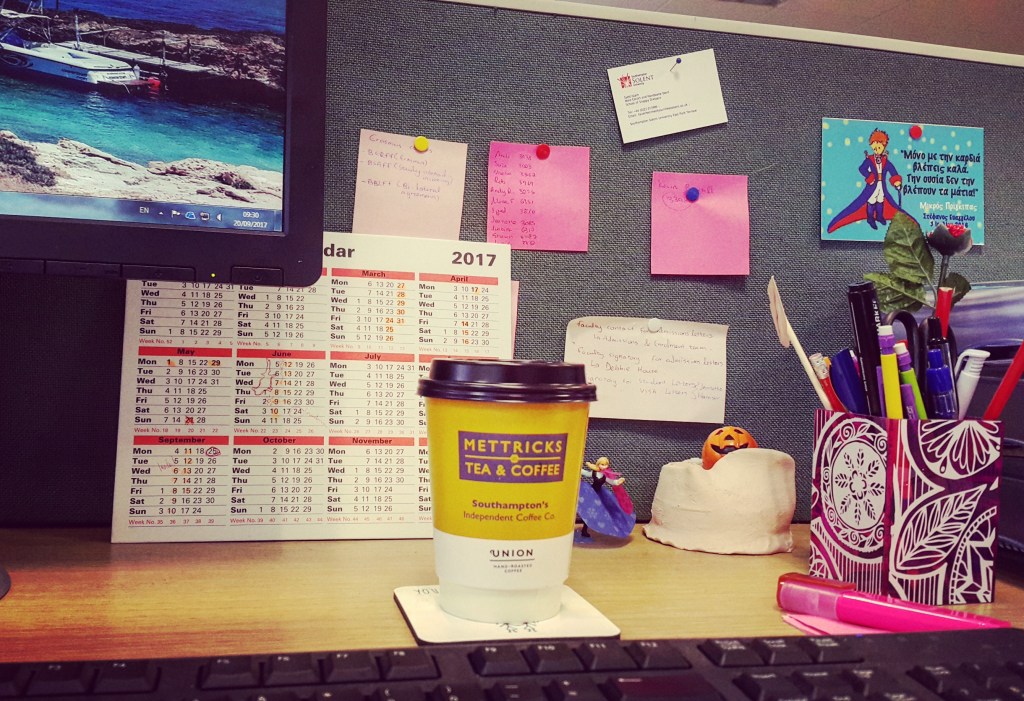
I’ve decorated my desk with memorabilia from home, gifts from colleagues and friends, Kinder Egg prizes because I embrace my childish side and I set up a gorgeous photo of my favourite Cyprus beach I took a year ago as my PC wallpaper. Anything that makes my surroundings colourful and pretty and reminds me of who I am helps. You spend most of your time at your desk, might as well make it feel homely, even if you wish you were anywhere else.

Music

Music is my saviour. It really is. I would simply not survive if I were not allowed to stick my headphones on and listen to music. I absolutely love Spotify and I’d pay more if I had to. Discover Weekly on Mondays, New Music Fridays and my personal long playlist with all my favourites for all moods which I go through several times a day depending on what I fancy to listen to at that moment. This is my playlist, which I add on every week if you want to listen to what I listen to, it has a little bit of everything, from indie to pop to rock to Greek music, not sure anyone else would like it, but even if it helps one person, then totally worth sharing it.

Regular breaks

If you sit at a desk all day, have short breaks every hour or so. It is recommended by Health and Safety! Get off your chair, go for a walk or just stand. And don’t spend your lunchtime at your desk. Make time to get out even if it’s in another room or a friend’s office or go for a wander at the nearest park. Lunch time is sacred, is you time, personal time, use it wisely.

Treat yourself

Every now and then I’ll treat myself to delicious coffee from my two favourite coffeeshops in town, Mettricks or Coffeelab or a nice lunch or an afternoon snack. Little treats go a long way!

Break the routine

There are many ways to do that, be creative. For me is essential to do something different every day, otherwise it feels like Groundhog day, over and over again. So I have lunch at different places through the week, I change my route to and from to work every couple of days, I try and do a couple of different tasks at work in a single day and not spend the whole day on just one thing, unless I have to.

Do what you love when you are not at work

Finally, what keeps me sane is what I do when I’m not at work. Find what makes you happy, what relaxes you, what you love and spend your evenings and weekends, however tired, drained or frustrated you might feel, doing these things.

For me is daily Yoga (Yoga with Adriene, which I’ve mentioned many a times here), my guitar, singing, blogging, drawing, reading, eating out, theatre, trying new things, photography, travelling and social media amongst others.

I love Instagram, I spend hours scrolling through travel photos, food (I love food), interior decoration, funny memes etc and I post a lot because I love taking photos. Twitter is my public journal. I follow and learn from inspirational people on LinkedIn and Facebook is for friends and family.

I spend a lot of time with my bestie (our daily chats is therapy for me) and other friends I love and since my family and best friends live in Cyprus, you’ll see me a lot of the time on my phone chatting to them.

Don’t forget how awesome you are

Yes, that’s right. You are awesome. When you are trapped in a dead-end job, the chances are you are scared to move on even when you can, because you lose your confidence, you forget all the skills and knowledge you proudly own. When I left Solent the first time, my then manager and now great friend Chris wrote on my leaving card not to forget how awesome I am at what I do and be confident on my abilities and I go back and read it whenever I go through a confidence crisis. I remind myself what Chris said and all the feedback I get from my current manager and my colleagues. I go through the messages and comments I get on my blog and Social Media posts and when I’m feeling low I remind myself that I’m better than I think.

This is how I manage. This is how I keep going until I can move on to a more exciting job.

Nobody will come out of nowhere and offer me my dream job, although that would be pretty awesome, so for now I’m exercising my patience and improving myself whilst keeping my eyes open for any opportunities I can go for.

Namaste

Eleni