Warm up ideas for online lessons

As a newly qualified EFL teacher in my first year I’ve been struggling immensely with information overload. There are hundreds of books, online resources, websites etc and what I ended up doing is to gradually, every couple of lessons learn something new, something practical that doesn’t take up a lot of time to adapt (no much free time I’m afraid, especially for new teachers!) and incorporate it into my teaching, I can’t possibly spend all of my time checking every single piece of information sent to me or even worse available online.

I don’t know about you, but ever since I switched to online teaching due to the Coronavirus nightmare, I’ve been bombarded with webinar links, lesson ideas, resources, almost every day, way more than I used to.

I found it extremely overwhelming and frankly I have no time to go through all of it, so again I read one thing or two, I focus on practical ideas, rather than activities that need a lot of time to prep (no time for that) and add it to every couple of lessons so I still enhance my teaching but I don’t fall into the trap of clicking on each link that comes my way.

I’ve been reading Interaction Online by Clandfield and Hadfield (2018) which is full of practical ideas, some of which I adapted as warm ups for my online lessons, mainly with my older teens and adults.

So if you’d like a few practical ideas, I put together a PPT with 5-6 of Clandfield and Hadfield excellent book and I thought I’d share so everyone can use. PS I highly recommend the book!

Hope you find it useful. Let me know if you try any of these.

Eleni

The ‘disillusionment’ stage (of first year of teaching)

It’s Saturday, just after 12pm, my body aches, I’m still sleepy and exhausted but I’m slowly getting ready for my mini break. My body is struggling, it could do with a few days of rest but my mind desperately needs this break.

I thought long and hard, I’ve been trying for a while now to accurately describe how I feel. I’m normally pretty damn good at it, but not lately. When asked I just say I’m tired but it’s much more than that.

I’m exhausted, I struggle to keep up with the energy levels required to teach, especially children and on some days I lack the motivation, particularly when teaching 4 lessons back to back, running around from school to school.

It’s not an easy job to say the least, let alone when you teach 8 large groups of 16- 25 children (plus two large classes of 16 yr olds, three one-to-ones and a group of adults which also have their own challenges) and after the 100th time that you repeatedly told a student or a class that you don’t speak Italian or waited for them to stop talking so they can listen or gave the same instructions but they just don’t seem to get it or they shout ‘Non capisco!’ even before you finish your sentence, well it becomes frustrating.

It makes me wonder whether this job is for me. Do I still enjoy it? I’m not even sure if I’m good at it. Will it get better? Will it get easier? If I decide to pursue this career does that mean I’ll never have free time again??

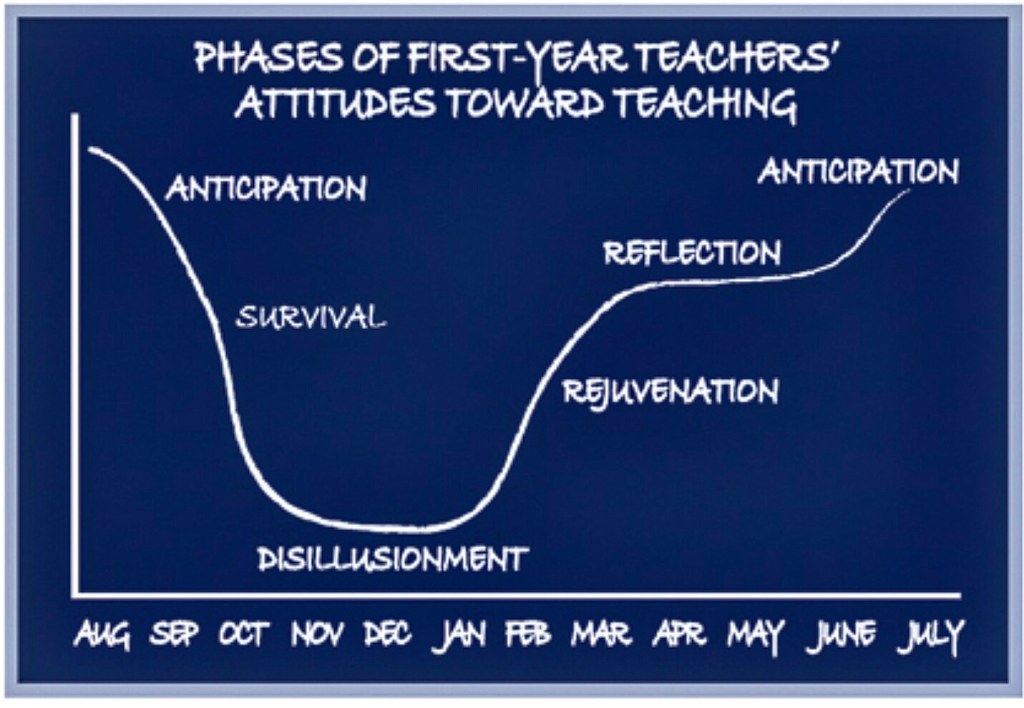
Then I remembered a little chart I came across last month, my friend and fellow teacher sent me a kind, encouraging open letter for first year teachers and in that letter it had the following graph (by Wisconsin Education Association) which is so far bang on the money.

To begin with it was exciting, the anticipation of applying everything I learned was off the charts and the first couple of months of teaching was all about survival, keep going, trying to plan amazing lessons in less time and improve whilst also having to do a million other things, but lately I feel sad and disappointed at times.

Disillusionment: a feeling of being disappointed and unhappy because of discovering the truth about something or someone that you liked or respected.

I’m not sure this is what I signed up for and I can’t but wonder whether this is for me, not just mentally but also physically. I guess the fact this is not my first job, I’ve lived and worked and led a different life plays a part. Perhaps this is just a phase. Some lessons are absolutely incredible, the students happily take part in most of the activities, they enjoy learning, I enjoy teaching them and time flies by, others there are so disappointing, disheartening, I don’t even want to be there.

It doesn’t help that I have very little free time to do other things not just work related e.g. lesson planning, if only I had more time to plan more engaging lessons, or time to read resources to help with my teaching and expand my knowledge but also just for myself: write, read, play my guitar, go for a walk, explore.

I’ll give it some time before I make a decision, maybe I’ll soon enter the ‘rejuvenation’ stage, but for now I just need to find the mental and physical strength to keep me going.

Who knows, maybe spending a few days in Barcelona, a city I’ve always wanted to visit, with my bestie who I haven’t seen for months, might do the trick and help me see things clearer.

Eleni

Survival guide for new EFL teachers

When we were asked by one of the DoS (Director of Studies) whether we’d like to present at the IH South Italy conference, although I was overwhelmed with all the additional work I took up on top of teaching (putting together promo videos and planning events, which I absolutely love but God it takes time) and barely had time to do anything else, I really wanted to.

I’ve never presented at a conference before. Sure I gave presentations at work and uni, but never at a conference.

‘But what can I talk about? I’ve only been teaching for two months, what can others learn from my experience?’

Most of the days I’ve been over stressed, overworked, overwhelmed, wondering whether I’m doing this well, if my students are really learning and whether all this it’s worth the anxiety, the lack of me-time, of any time to do anything else other than work. If you are a newly qualified teacher you probably nodding your head reading this.

And that’s when I had a light bulb moment. What if I put together a ‘survival guide’ for newly qualified English teachers using the wisdom of existing teachers? I’ve already learned a lot from my manager, our DoS and fellow teachers in the couple of months I’ve been working as an EFL teacher, so imagine gathering all these little nuggets of advice and summarising them into a couple of pages?

I asked James (one of our DoS and the kindest man on earth) if he thought that would be a good idea and he seemed to like it. It’s hard to tell if he really liked it or he was just being polite as he always is but I thought ‘Let’s do it’, I might not get the chance again, who knows where I’d be and what I’d be doing next.

I asked around the room if anyone wanted to present with me, not that I was shy presenting on my own, but there are a lot of NQTs in our school and it would be a good opportunity for someone if they’d like to present. One of my fellow teachers wanted to present with me and to cut a long story short I set up a survey, sent it to teachers we knew and posted it on FB groups and got around 40 responses in just two weeks. Time management is a huge issue for new EFL teachers!

We gave the presentation at the IH South Italy conference yesterday, summarising and demonstrating some of the most common advice on topics we, newly qualified EFL teachers struggle with the most, and I thought I’d share it here too, to hopefully help other newly qualified teachers who may be struggling.

The CELTA can’t prepare you for what’s about to happen when you start teaching children or large classes or full time (also forget CELTA lesson planning time when you start teaching 4-5 hours a day!) so if you need any ideas on how to reduce your lesson planning time and manage your time better in general, or what you can do to help you with teaching young learners, or how to look after your mental health and wellbeing, have a read below.

What I’ve learned so far and I’d advise others (which most teachers recommended in the survey):

-Always have pre-prepared, low resource activities in hand (see ideas below) or lesson plans you have already prepared (start building your own archive), so if you hadn’t had time to plan in detail or ran out of material you can still have a great lesson.

– Plan less, don’t spend hours on it. Most of the time you can’t afford to spend hours. Not every lesson has to be amazing with heavy resource and planning activities. Use the coursebook and extend/adapt some of the exercises, students will still enjoy it (though it is more fun not using the book, especially if the material is not engaging for the students).

-Ask for help. We all regardless of experience give each other ideas and we all help each other with little and not so little things. And if you are struggling, talk to someone!

-Make time for yourself, your hobbies, your passions. Teaching shouldn’t take over your whole life. There is is much more in life than work.

-Making a mistake is not the end of the world. In fact that’s how you learn!

-Look after yourself. Rest, have breaks, sleep. At the end of the day teaching is just a job. If you don’t enjoy what you are doing/ you are too tired/ drained it not only affects your teaching but it’s not worth doing if it compromises your mental and physical health.

(the session started with a 5 minute mindfulness activity I’ll share on another post and also included demonstrations of a classroom routine, giving clear graded instructions, planning an activity for a lesson in a few minutes-yes, it’s definitely do-able- and finished with the audience getting to know each other outside their teacher remit and catching up with friends they haven’t messaged in a while).

Feel free to share and spread the wisdom. The survey is still open if you’d like to share yours. I thought instead of closing it, try to get as many teachers filling it in with their own ideas and advice instead (https://forms.gle/7wqyKbtQ789jVLeu9).

Thank you to everyone who filled in the survey, my co-presenter Nour, my lovely colleagues Maria and Mariah for their super useful feedback and ideas and a very special thank you to James who not only advised and helped me with the survey and PPT from the beginning, even during the Christmas holidays but also for his encouragement and mental support. He even saw the session twice. What a man.

Eleni