Warm up ideas for online lessons

As a newly qualified EFL teacher in my first year I’ve been struggling immensely with information overload. There are hundreds of books, online resources, websites etc and what I ended up doing is to gradually, every couple of lessons learn something new, something practical that doesn’t take up a lot of time to adapt (no much free time I’m afraid, especially for new teachers!) and incorporate it into my teaching, I can’t possibly spend all of my time checking every single piece of information sent to me or even worse available online.

I don’t know about you, but ever since I switched to online teaching due to the Coronavirus nightmare, I’ve been bombarded with webinar links, lesson ideas, resources, almost every day, way more than I used to.

I found it extremely overwhelming and frankly I have no time to go through all of it, so again I read one thing or two, I focus on practical ideas, rather than activities that need a lot of time to prep (no time for that) and add it to every couple of lessons so I still enhance my teaching but I don’t fall into the trap of clicking on each link that comes my way.

I’ve been reading Interaction Online by Clandfield and Hadfield (2018) which is full of practical ideas, some of which I adapted as warm ups for my online lessons, mainly with my older teens and adults.

So if you’d like a few practical ideas, I put together a PPT with 5-6 of Clandfield and Hadfield excellent book and I thought I’d share so everyone can use. PS I highly recommend the book!

Hope you find it useful. Let me know if you try any of these.

Eleni

The ‘disillusionment’ stage (of first year of teaching)

It’s Saturday, just after 12pm, my body aches, I’m still sleepy and exhausted but I’m slowly getting ready for my mini break. My body is struggling, it could do with a few days of rest but my mind desperately needs this break.

I thought long and hard, I’ve been trying for a while now to accurately describe how I feel. I’m normally pretty damn good at it, but not lately. When asked I just say I’m tired but it’s much more than that.

I’m exhausted, I struggle to keep up with the energy levels required to teach, especially children and on some days I lack the motivation, particularly when teaching 4 lessons back to back, running around from school to school.

It’s not an easy job to say the least, let alone when you teach 8 large groups of 16- 25 children (plus two large classes of 16 yr olds, three one-to-ones and a group of adults which also have their own challenges) and after the 100th time that you repeatedly told a student or a class that you don’t speak Italian or waited for them to stop talking so they can listen or gave the same instructions but they just don’t seem to get it or they shout ‘Non capisco!’ even before you finish your sentence, well it becomes frustrating.

It makes me wonder whether this job is for me. Do I still enjoy it? I’m not even sure if I’m good at it. Will it get better? Will it get easier? If I decide to pursue this career does that mean I’ll never have free time again??

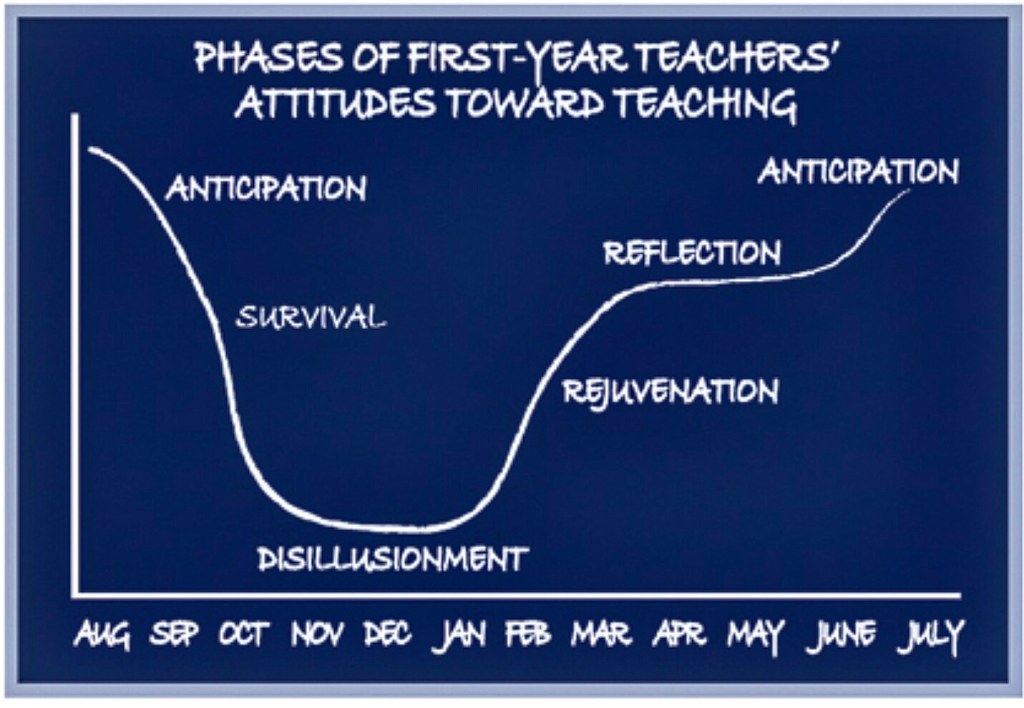
Then I remembered a little chart I came across last month, my friend and fellow teacher sent me a kind, encouraging open letter for first year teachers and in that letter it had the following graph (by Wisconsin Education Association) which is so far bang on the money.

To begin with it was exciting, the anticipation of applying everything I learned was off the charts and the first couple of months of teaching was all about survival, keep going, trying to plan amazing lessons in less time and improve whilst also having to do a million other things, but lately I feel sad and disappointed at times.

Disillusionment: a feeling of being disappointed and unhappy because of discovering the truth about something or someone that you liked or respected.

I’m not sure this is what I signed up for and I can’t but wonder whether this is for me, not just mentally but also physically. I guess the fact this is not my first job, I’ve lived and worked and led a different life plays a part. Perhaps this is just a phase. Some lessons are absolutely incredible, the students happily take part in most of the activities, they enjoy learning, I enjoy teaching them and time flies by, others there are so disappointing, disheartening, I don’t even want to be there.

It doesn’t help that I have very little free time to do other things not just work related e.g. lesson planning, if only I had more time to plan more engaging lessons, or time to read resources to help with my teaching and expand my knowledge but also just for myself: write, read, play my guitar, go for a walk, explore.

I’ll give it some time before I make a decision, maybe I’ll soon enter the ‘rejuvenation’ stage, but for now I just need to find the mental and physical strength to keep me going.

Who knows, maybe spending a few days in Barcelona, a city I’ve always wanted to visit, with my bestie who I haven’t seen for months, might do the trick and help me see things clearer.

Eleni

Survival guide for new EFL teachers

When we were asked by one of the DoS (Director of Studies) whether we’d like to present at the IH South Italy conference, although I was overwhelmed with all the additional work I took up on top of teaching (putting together promo videos and planning events, which I absolutely love but God it takes time) and barely had time to do anything else, I really wanted to.

I’ve never presented at a conference before. Sure I gave presentations at work and uni, but never at a conference.

‘But what can I talk about? I’ve only been teaching for two months, what can others learn from my experience?’

Most of the days I’ve been over stressed, overworked, overwhelmed, wondering whether I’m doing this well, if my students are really learning and whether all this it’s worth the anxiety, the lack of me-time, of any time to do anything else other than work. If you are a newly qualified teacher you probably nodding your head reading this.

And that’s when I had a light bulb moment. What if I put together a ‘survival guide’ for newly qualified English teachers using the wisdom of existing teachers? I’ve already learned a lot from my manager, our DoS and fellow teachers in the couple of months I’ve been working as an EFL teacher, so imagine gathering all these little nuggets of advice and summarising them into a couple of pages?

I asked James (one of our DoS and the kindest man on earth) if he thought that would be a good idea and he seemed to like it. It’s hard to tell if he really liked it or he was just being polite as he always is but I thought ‘Let’s do it’, I might not get the chance again, who knows where I’d be and what I’d be doing next.

I asked around the room if anyone wanted to present with me, not that I was shy presenting on my own, but there are a lot of NQTs in our school and it would be a good opportunity for someone if they’d like to present. One of my fellow teachers wanted to present with me and to cut a long story short I set up a survey, sent it to teachers we knew and posted it on FB groups and got around 40 responses in just two weeks. Time management is a huge issue for new EFL teachers!

We gave the presentation at the IH South Italy conference yesterday, summarising and demonstrating some of the most common advice on topics we, newly qualified EFL teachers struggle with the most, and I thought I’d share it here too, to hopefully help other newly qualified teachers who may be struggling.

The CELTA can’t prepare you for what’s about to happen when you start teaching children or large classes or full time (also forget CELTA lesson planning time when you start teaching 4-5 hours a day!) so if you need any ideas on how to reduce your lesson planning time and manage your time better in general, or what you can do to help you with teaching young learners, or how to look after your mental health and wellbeing, have a read below.

What I’ve learned so far and I’d advise others (which most teachers recommended in the survey):

-Always have pre-prepared, low resource activities in hand (see ideas below) or lesson plans you have already prepared (start building your own archive), so if you hadn’t had time to plan in detail or ran out of material you can still have a great lesson.

– Plan less, don’t spend hours on it. Most of the time you can’t afford to spend hours. Not every lesson has to be amazing with heavy resource and planning activities. Use the coursebook and extend/adapt some of the exercises, students will still enjoy it (though it is more fun not using the book, especially if the material is not engaging for the students).

-Ask for help. We all regardless of experience give each other ideas and we all help each other with little and not so little things. And if you are struggling, talk to someone!

-Make time for yourself, your hobbies, your passions. Teaching shouldn’t take over your whole life. There is is much more in life than work.

-Making a mistake is not the end of the world. In fact that’s how you learn!

-Look after yourself. Rest, have breaks, sleep. At the end of the day teaching is just a job. If you don’t enjoy what you are doing/ you are too tired/ drained it not only affects your teaching but it’s not worth doing if it compromises your mental and physical health.

(the session started with a 5 minute mindfulness activity I’ll share on another post and also included demonstrations of a classroom routine, giving clear graded instructions, planning an activity for a lesson in a few minutes-yes, it’s definitely do-able- and finished with the audience getting to know each other outside their teacher remit and catching up with friends they haven’t messaged in a while).

Feel free to share and spread the wisdom. The survey is still open if you’d like to share yours. I thought instead of closing it, try to get as many teachers filling it in with their own ideas and advice instead (https://forms.gle/7wqyKbtQ789jVLeu9).

Thank you to everyone who filled in the survey, my co-presenter Nour, my lovely colleagues Maria and Mariah for their super useful feedback and ideas and a very special thank you to James who not only advised and helped me with the survey and PPT from the beginning, even during the Christmas holidays but also for his encouragement and mental support. He even saw the session twice. What a man.

Eleni

Thankmas Day Twenty-Three: Thank you IH Reggio

Four months ago I had no idea what or where Reggio Calabria was. I’d never heard of it before and also until four months ago, I’d never taught anything to anyone.

Fast forward to now and I’ve been living at Reggio for just over two months. I haven’t seen much yet and what I think of it so far it’s not an accurate representation (more on that another time). I’ve been mainly working, teaching a wide range of ages and levels, from large classes of 9, 11, 13 and 16 year old school children to one-to-one with a 50 something old doctor and a 14 year old teenager.

But I haven’t just been teaching. I marked and invigilated tests, I had the chance to organise and be part of different events, I filmed and edited a couple of promos for the school, I am now presenting at a conference next month and organising an event as well for February.

It’s been a crazy two months as you can probably guess. Rewarding, challenging, stimulating.

But…

oh my God.

It’s exhausting. I feel mentally and physically drained. And I honestly wouldn’t have survived these two months without my fellow teachers.

Teasing Nour on a daily basis, having a laugh with Katie (my favourite face) and Hannah (creative genious), exceptional A-class sarky humour with Vince and Bry, chats outside with my Italian spirit twin, Antonella, giggles and random convos with Shannon, talking TV series and films with Matt, reminding Alexei his Greek, reminiscing life before teaching with Kate on our way to Telesio, travelling chats with Maria, singing along with Mariah and Nuno, giggles with Fanni, making a serious effort to tease Lisa with Beatles and Christmas songs, talking Christmas filims with Jen, stealing precious little moments to chat to Lucie when I see her, all sorts of random convos with Suzanne, Italian lessons with Anna, brainstorming ideas with Helena and comforting each other, making James laugh (I love making James laugh), chats with Cesca on our way back from externals, having a laugh with my favourite reception team, Carlo, Elena, Domi, Franci and little catch ups with the bosses Marco and Patrizia when they pop in every now and then.

So thank you EVERY ONE!

Thank you Patrizia, James and Lucie for offering me the position and making me feel welcome from day one and most of all a huge thank you to this beautifully weird, fun, unique bunch of people. I would have genuinely quit by now if it weren’t for you.

Eleni

Thankmas Day Twenty-One: Thank you Priya and Syed

Wednesday, 21st of August, 2019

I had just finished my last assessed teaching practice. The feeling of relief was indescribable. I did it, I couldn’t believe I actually managed to finish my CELTA. And I couldn’t believe that two my sweetest friends, Syed and Priya, took the day off to visit Cambridge and see me before I was to fly back to Cyprus.

As soon as I left college I headed into the town centre to meet them and I was so happy I nearly cried.

You may not realised it but that was exactly what I needed that day. After a month long, sleep and fun deprivation, away from all my friends, worrying they may forget me now that I’m leaving the country, it meant the world to me that two of them were there with me, celebrating my success.

So thank you Priya and Syed. Thank you for being such sweet, caring friends and for making the trip to Cambridge. It meant the world to me. I miss you!

Eleni

Thankmas Day Twenty: Thank you Barnaby and Maro

I remember just after my interview when Barnaby handed me a bunch of Cambridge English exam books.

I didn’t have a single clue about any of it and I found everything overwhelming.

For about a month I spent hours and hours on planning just four lessons a week. Who knew a month later I’d teach four lessons a day and have an hour or two to plan everything!

If it weren’t for Barnaby and Maro, who offered me my first teaching position only a few weeks after my CELTA, I wouldn’t be where I am today.

So thank you both and sorry I left so soon. I had to follow my heart. I’m not sure whether it was the right decision yet, only time will tell, but I’ll forever be grateful to you.

Eleni

Eleni

I won’t know where I’m going if I don’t know where I am…

A few days ago, I woke up in a sweat, tears streaming down my face, in the middle of the night. I saw my uncle Spyro in my dream, he looked so alive and healthy but he was sad. He knew he was going to die and I was painfully aware he was already dead. It took me a few seconds to realise where I was. I’m in Italy. How on earth all of this happened in just few months?

That’s when it hit me.

I have no idea what is going on. Not a clue. Now that the dust has settled and I’m getting into a routine, a routine I’m not familiar with and not quite sure how it should be, teaching English in a foreign country is brand new to me, I’m making time for myself to reflect, to make sense of what has happened in the last few months.

I don’t know where to start and how to end this post but here it goes.

I still sometimes feel I’m on a long, albeit random and bizarre holiday and I’ll be returning to the UK anytime now. I don’t miss my job, or the grey weather, OK I do miss British autumn, golden leaves across the park, hot chocolate at Mettricks, reading a book or watching silly TV on a Saturday afternoon with a blanket, a cup of tea and some chocolate biscuits whilst pouring down with rain outside, but other than that I don’t miss the UK.

I miss things from the UK, the convenience of it all (Amazon Prime aaah), actual little daily things like decent tea, Hobnobs and Chocolate Digestives, but most of all I miss my friends, my dear friends. Not that I don’t love my new colleagues and friends I’ve made already, but I miss my people.

So far I’ve enjoyed working as an EFL teacher. But is this the career I’d like to follow?

I don’t know, I genuinely don’t. I don’t even know if I’m any good at it. I’ll soon get feedback from my managers after they observe me but for now I’m doing what I think best.

Of course if I decide that’s not what I’d like to do long-term I can change careers again, but to do what?

For now I’ll give it time and not think that far ahead, but it’s always at the back of my mind.

I’m strangely not stressed or too anxious, not as much as I expected I’d be. Being one of the oldest teachers and having lived life already comes with its perks I guess. I do sometimes feel I let the rest of them down when I’m too tired or too ill or too old (in a ‘been there, done that’ sense) to follow them in some of their excursions.

It’s still unclear in my head whether I pursued this so fast to not disappoint my tutors who gave me a Grade A or to avoid dealing with my grandpa and my uncle’s deaths, I feel I haven’t processed still what has happened.

I remember the last time I was at my grandpa’s house, where my auntie now lives alone, without pappou Costa or theio Spyro and I caught myself waiting for them to show up. A horrible, sad realisation they will not ever again.

I also feel terrible guilt. I feel guilty I didn’t give my home, Cyprus more time. I was so occupied worrying not to get stuck I left after just a month. I didn’t travel across the island, I didn’t see all my friends and family. I needed an escape and ended up changing my plans at the very last minute.

I know deep in my heart I made the right decision leaving my job and leaving the UK. I’m not sure I made the right decision rushing into my first ELT job, but time will show.

For now I need to find myself again, I have felt the black cloud of depression getting closer over the last week and I desperately want to keep it away.

I need my remedies, my writing (which I’ve done a lot, this terrible cold I can’t shake off did me good in other ways), my Yoga- God I miss Adriene-, my guitar- God I miss my guitar-, and I need to feel like myself because at the moment… (I couldn’t have described it better than Wind and the Wave’s Lost)

That I won’t know where I’m going
If I don’t know where I am
But I feel more
I feel more
Lost

Eleni

Teaching English abroad- Step 2: Full time CELTA

‘You won’t have any other life for a month.’

Jonny did warn me at the interview, as I assume all CELTA tutors do with their potential students (full details of the interview process here), but no amount of explaining and warning can prepare you for doing a full-time, intensive, month long CELTA course. A level 5 qualification (equivalent to HNC/HND) which normally takes between 6 months/ 1 year full time and 2 years part time squeezed in one month!

Lead in, TPs, Gist Task, Detailed task, Guided Discovery, Monitoring, you pick up the CELTA language from week 1, that’s how intensive it is.

I’ll talk about my experience at Cambridge Regional College but I’m certain the format and the content are similar across the world, as they all follow the Cambridge English syllabus, though not everyone might have been lucky enough to have had such great tutors, classmates and students.

A. format

We started the course on a Friday, to give us time to get to know each other and our surroundings and on the following Monday we taught for the first time, just an introductory, non-assessed class. The following day we had to teach our first assessed Teaching Practice (TP), extremely stressful for someone who struggles with anxiety like me, but it helped we got to know the students the day before first. With most education providers you are required to teach your first assessed lesson on day two. Yes, it’s pretty intense from the start.

-Input sessions

Every morning we had input sessions, where Jonny and Fiona in turns covered the main topics of EFL teaching: learners and teachers, and the teaching and learning context, language analysis and awareness, language skills: reading, listening, speaking and writing, planning and resources for different teaching contexts and developing teaching skills and professionalism. For more details you can check the Cambridge English CELTA syllabus here.

Input sessions with those two were never dull, they were always fun, engaging and creative, even with typically boring, dreadful subjects like teaching grammar. Jonny’s colour- coordinated flashcards and phonetics jokes were superb and Fiona’s energy, honesty and saying things as they were were refreshing. I won’t go into much detail, I wouldn’t like others to steal Jonny and Fiona’s hard work but I’m not sure many CELTA students got to mime, dance and laugh as much as we did whilst learning.

-Teaching

In the afternoons we were split into two groups. Half of us taught the pre-intermediate group and the other half the upper intermediate (and we switched half way, every teacher has to teach two levels). When we were not teaching we observed and gave feedback to each other. Jonny or Fiona (in turns) were always there assessing and providing us with feedback after each session. We taught six 40 min and two 1hr long sessions (8 sessions and 6 hours in total).

Don’t worry if you’ve never taught before, I hadn’t before this. We were provided with lesson frameworks to use from day one and every morning the day before we were to teach we met with our tutor to help us with the lesson planning, except for the last two sessions where assistance with planning was also assessed and varied depending on what grade you were aiming for (more on that on a separate post).

-Observing

You are also required 6 hours of observing experienced teachers. We observed summer school teachers in the classroom, a video-taped session and our tutors who both were AMAZING at their teaching and way better than the rest we observed. Engaging, building rapport almost instantly, monitoring effectively and making the class fun and interesting. That’s how I aspire to teach.

-Assignments

As if lesson planning, input sessions, teaching and observing are not enough you also have to prepare and hand in 4 assignments, around 1000 words each covering the main topics mentioned above. It’s hard work this course!

-Grades

Possible outcomes are:

-Pass A (about 5% of successful candidates).

-Pass B (about 25% of successful candidates)

-Pass (about 70% of successful candidates)

-Fail

Fiona told us from day one she won’t let anyone fail and nobody did.

B. Day to day work

You may assume you go home around 5pm and you only need an hour or two preparing for the next day but that’s not the case. Lesson planning takes, especially to begin with, at least 4-5 hours- ‘Double the time you think it will take’ Fiona used to say and she was right- and the more you progress through the course the more exhausted, sleep deprived and stressed you become, which slows everything down significantly.

C. How to make it

  • Classmates

All ten of us used to go in as early as possible so we can finish our lesson plans, print our handouts and/or help each other with assignments. Honestly we wouldn’t have made it without each other. I certainly wouldn’t.

We all reached our limit and were about to quit, particularly towards the end of week two. We were warned that would happen, though nobody told us it would happen more than once. If you really want this qualification, persevere. You will feel like quitting at least once, but the sense of achievement will more than make up for it in the end.

Most of us were not from Cambridge, we had no family or friends around, we lived and breathed CELTA for a month and that takes its toll. We kept each other going, read and corrected each other’s assignments, lesson plans, hand outs. We cried together, we laughed together. We bonded a lot, very fast. It’s inevitable when you spend every day with the same people, trying your best for the same thing.

Having a WhatsApp group helped a lot not just with homework but also mentally. Sharing our frustrations and worries was therapeutic.

This may not be the case with everyone who does the CELTA. I think I was lucky I had such sweet, caring, brilliant, funny, all round awesome classmates I now call friends. I miss you all!

  • Tutors

I’ve touched a bit on this already but I feel we were lucky we had such great tutors. It’s obvious they love what they do and they are incredibly amazing at it. They passed on their enthusiasm, skills and knowledge to us, so when we get out there and teach we care and we do it right.

They were there before us in the morning and left after us most days. Whilst they had to train us, they also had to deal with the rest of their day to day job in between as well as read and mark our assignments.

Both Fiona and Jonny supported us as much as they possibly could, me personally, when I was going through my grief having lost my grandpa on week one. I cried in front of them on my first week and they were both understanding, they offered me a break and checked up on me.

Also I wouldn’t have been able to manage my stress and teach so effectively if it wasn’t for Fiona. She helped me more than she realised. She is awesome.

  • Students

I got to teach two lovely groups of students. Before my first teaching session I was terrified of what I was about to face but by the end of the course I loved everyone in both classes. People from all over the world, Italy, Spain, Brazil, Colombia, Lithuania, you name it, who happened to now live in Cambridge and just wanted to improve their English all came together and I was blessed with teaching them. I got to know and chat to every single one of them outside the class, have a laugh with them and hopefully taught them a thing or two.

  • Accommodation

Most of my classmates were not from Cambridge or the UK, so we all lived in a brand new environment dealing with all sorts of situations whilst studying hard every day.

I lived with a host ‘family’, it was only the landlady, Mary in my case, who also provided breakfast and dinner every day and did my laundry every week. It was challenging at times, especially when all the rooms were occupied, noise, queue for the bathroom (though they were three!) but all in all it was brilliant. Mary looked after me and I made great friends, not just Mary but also my Russian flatmates! If you have the option I definitely recommend it, you won’t have time to cook or do anything else for a month, it helps to have dinner prepared for you and a clean room to your disposal.

Overall thoughts

The 4 week CELTA course was one of the most mentally and physically challenging things I ever had to do, it tested my sanity, my health, my limits in more than one way and my anxiety flared up bad, I didn’t sleep more than three/four hours a day, I didn’t get to see much of Cambridge but it was also incredibly rewarding and fulfilling, at least for me. I learnt a lot, I fell in love with teaching and I made friends in Cambridge and all over the world, from Peru to Italy and Azerbaijan. Once in a lifetime experience I’ll never forget.

If I had to do it again I’d may opt for the part-time option, though that has its challenges too if you work full-time, and it may take longer to learn as you don’t apply what you learn immediately, but I don’t regret a single moment.

If you decide to do it full time, I’d with no second thought recommend Cambridge Regional College.

If you do it in Cambridge, go a few days early or stay a few days after to enjoy what this gorgeous city has to offer. I’d love to go back some time and go punting, visit the Wren Library, have afternoon tea at Grantchester and do yoga in the park by the river. Who knows, maybe I will one day.

After thoughts

Despite no previous teaching experience I managed to get the highest grade (Grade A), so it is possible, but I will write about that on a separate post.

I just started a part-time job teaching A1 Movers and A2 Key young learners, the CELTA can’t prepare you for that I’m afraid. I’ll write about that soon too but any advice would be greatly appreciated.

Eleni

Following my dreams (just need to find out what they are) Chapter 1: Cambridge

Saturday morning, 27th of July.

I’m sitting at an old, antique desk in my room in Cambridge. It’s cloudy and raining but I don’t mind for once. I needed the break from the heat. This country was not built for any temperature higher than 25 degrees.

Can I sleep in Your Brain comes up on my little Bluetooth speaker. I just finished my notes for my first teaching exercise on Monday and finally have some free time to sit down and write about all of this. It’s been too long.

A million and one thoughts in my mind I’m not quite sure where to begin.

Today is my grandpa’s birthday. He turned 83. But this time I can’t call him like I do every year. He is at a nursing home. Now my uncle’s recovering from a major operation, my auntie can’t look after both of them.

“He won’t even recognise you”, my mum messaged when I asked how I can contact him. “His dementia is taking over more day by day”. She sent me a picture I took of him and myself a few years ago. A classic mum habit. I told her off not because I was annoyed this time but because it makes me sad. I remember everything about that picture, his excitement when I asked for a selfie, laughing whilst taking it, asking me where to look and afterwards chatting about me splitting with my ex of 7 years.

“Are you happy? That’s all that matters” pappou Costas said then and smiled.

Tears came streaming down my face thinking of that day. (A few hours later my mum messaged me to give my aunt a call. She was with my grandpa. I called and wished him happy birthday. He recognised me at the beginning but not for the whole duration of the two minute phone call. I could feel his confusion every time he went quiet. At some point he asked me when I’ll go back to Cyprus like he always does and then the next minute he forgot what he was talking about. I promised I go see him as soon as I’m in Cyprus. He said he might leave by then. I choked up. I hope he meant the nursing home. He is slipping away from us…)

I tried hard not to cry last week saying goodbye to my Southampton friends and life, it didn’t feel like goodbye, my brain still struggles to understand what is happening. It feels I’m on a break and I’ll return back to Southampton any minute now.

I don’t think I’ll realise any time soon. One thing is for sure, I will miss so many people, friends I’ve known for years and friends I’ve only just met, because that’s life. It never stops, you meet people and make friends all the time. Thank you to everyone who came to my leaving celebrations (and they were MANY) or made the time to see me before I left.

I will miss every single one of you and all the little special connections I have with each.

Now I’m crying about everything. But I feel good. These are not sad tears. These are cathartic tears, letting everything out and finally hitting the reset button.

Last month feels like a blur. Friends’ birthday celebrations, after work drinks, Graduation week, the stress of dealing with removal companies, getting rid of furniture, cleaning, throwing out things. It was fun, bittersweet, exhausting.

I’ve been living in Cambridge for about three days now and I’m surprised how well I adjusted from living on my own to living with a house full of people (minus a few sleepless nights because of the strong anxiety and heat cocktail mix).

My hostess Mary is wonderfully weird. Though she’s lived in the UK for 28 years, her accent is so strong I struggle to understand her at times but she is adorable. Her cooking is amazing. She won’t let me do my own washing, it’s been years since someone else washed my clothes.

She wears a plastic bag on her head when she makes fish to keep the smell away (I chuckled when I walked into the kitchen for some water and saw her wearing the bag, she then told me to rush so I don’t smell like fish either), she hangs the bed sheets off the staircase to dry faster, unintentionally creating a little fort I found too amusing, and she randomly knocks on my door to ask for help with translation or to give me treats. I haven’t tasted melon that sweet since the last time I was in Cyprus.

My room is small but perfectly formed. Clean with all the essentials. The bathroom is sparkling clean and I only share it with one other. There are two kitchens, both huge, especially the guests one. I’m glad I opted for the host family option (though it’s just Mary, her adult children don’t live here, so thankfully no toddlers are running around screaming off their head), though I worry I’ll soon miss living on my own. It will happen eventually.

On Thursday, when the temperature outside hit 38 degrees, I decided I’d go out to explore Cambridge a little bit, since my course was to start the following day and I may not get the chance to do much wandering when I have homework. ‘I lived in Cyprus for 22 years after all, I can take some heat, if I get to live in a hot country from January, this could be my daily reality’ I told myself.

I’m glad I did (though I can’t remember the last time I sweat that much it felt like peeing myself). Cambridge is gorgeous, there is so much to see and do and a couple of friends already suggested places I’d love to go before I leave the city at the end of August.

Yesterday I had my first day of CELTA teacher training class. It was intense, exhausting but incredibly fun. Going to college, buying stationery, finally using my brain again, felt rejuvenating, even just after a day.

Most of the studying I did throughout my life (and I’ve done a lot, from degrees, to qualifications, diplomas etc), in only few occasions I cared enough to actively participate in the classroom. With this one I wouldn’t shut up. The perks of being a mature student or maybe in my case, finally being confident comfortable enough with myself to not worry too much about what others think.

Fiona, our tutor who ran the session on the day, is amazing (I hope Jonny is as good, though it will be tough to beat Fiona).

My classmates are all very beautifully different and unique, a wonderfully diverse bunch. Some travelled from their home countries, Bangladesh, India, Azerbaijan, Spain just to do this course, others are semi-retired and doing it for fun or to follow their partner to Colombia (ah young love). I’ll write about the course separately when I get the time.

I oddly felt more British even than the British in the group. I guess I’ve lived here for too long. And to think I worried I might find it hard with my accent and everything doing this course.

I worry I’ll struggle in Cyprus. And I worry about so many other things,- Will my stuff make it Cyprus? Will I get my deposit back? Will I manage to keep up with the amount of studying required? Will I make it to Chris’s wedding? What if my uncle or grandpa die and I don’t get to see them again? What if I’m not good enough for anything else and this is a huge mistake? – But I need to stop worrying. There’s nothing I can do about any of this and choosing to leave the comfortable but dull 9 to 5 life means there will be a lot more to worry about.

For now I’ll work hard to get my qualification and enjoy every moment in Cambridge.

Here’s to new beginnings.

Eleni

Teaching English abroad- Step 1: Getting qualified.

Ever since my big news a few weeks ago a couple of you asked me about the course I’m planning to do and how to get into teaching English abroad, so I thought I’d document my experience, every step of the way as I live it, to hopefully help others considering doing something similar. So this post is about…

Step 1: Getting a relevant qualification

You have a few options when it comes to getting a relevant TEFL (Teaching English as a Foreign Language) qualification.

a) Do I need one?

If you are a teacher or a native speaker you may be able to land a TEFL job with no qualification whatsoever, but opportunities would be more limited, and that also means (especially if you have no teaching experience) you might end up in a foreign country alone with no clue on how to even begin teaching English.

b) What about online courses?

There is a huge number of TEFL courses out there (and too much information, it can be very confusing). Online, classroom, combined, cheap, expensive e.g.
https://www.theteflacademy.com/course-location/southampton

A short online, relatively cheap course is a good option if you are only looking to refresh your Grammar knowledge, learn more about teaching in general as well as teaching English as a foreign language. Some of them are recognised by various regulatory bodies but some countries only accept one of the two classroom based, internationally recognised or equivalent qualifications, Cambridge CELTA and Trinity CertTESOL. With these two diplomas you will also be qualified to teach English for academic purposes (pre-sessional English courses) at UK universities.

c) CELTA or CertTESOL?

CELTA (Certificate in Teaching English to Speakers of Other Languages) is
provided by Cambridge English Language Assessment through authorised Cambridge English Teaching Qualification centres and CertTESOL (Teachers of English to Speakers of Other Languages) is awarded by Trinity College London. When it comes to choosing between the two, I’m not sure myself whether one might be slightly better than the other, the content is very similar, but after some research I did, it seems CELTA is better known and that may open more doors for me (and if you decide to apply for funding, the Advanced Learner Loan covers the majority of the tuition fees charged for CELTA at most colleges but only partially for CertTESOL, more on that below).

Both CELTA and CertTESOL are level 5 qualifications, offered full-time, part-time and online but face-to-face assessed teaching as the practical element is what separates them from the rest. The full-time variant is a month long-9am-to-5:30pm-five days a week, intense course whereas the duration varies when it comes to part time options, from 3 months up to a year, depending on the training provider.

I opted for the month long, intense one. It’s a great challenge and you are done in four weeks. Though that will be your life for those four weeks. No time for anything else. You are pre-warned by EVERYONE who has already done it and the course trainer.

When deciding where to apply, make sure you check the training providers offering them are accredited (for CELTA you can check here and for CertTESOL here)

d) Any funding available?

For both CELTA and CertTESOL you can apply for an Advanced Learner Loan(ALL) at specific providers, which will cover your tuition fees up to £811 for CerTESOL, that may not cover the tuition fee and £1417 for CELTA which is what most providers charge for it (list here for CELTA and here for TESOL). Oh by the way, there is a long list of qualifications you can get an ALL for! All details about the loan, repayment terms etc here.

e) What’s the application process like?

Applying was a bit scary for me, since I haven’t applied for any course for a long, long time and my self-confidence levels are running a bit low lately, but it wasn’t half as bad as I thought it’d be.

I applied at Cambridge Regional College, so what I’ll describe is their application process but it’s very similar to most of other providers.

Pre-Interview task. Part of the application (in addition to the usual personal and education information) is a pre-interview task mainly consisting of grammar, syntax questions and ways you’d teach various English language related items. See examples here. I was allowed to use books and the internet for my answers.

-The interview. I was very nervous on the day, I was terrified I’d be asked a million grammar questions on the spot, but it wasn’t that bad at all. Jonny, the course trainer and interviewer was very sweet and put me at ease straight away.

I was offered a Skype interview, it would have been a nightmare getting to Cambridge at 10am, so I spent a tenner to get a chair for the dining table (I could have sat on the sofa, but in my head it seemed unprofessional), an unhealthy amount of time deciding where to set the table, where to put the chair and so on (of course the overthinking took over).

I woke up early, had breakfast, did my make-up, put a nice semi-formal top on (I kept reminding myself this was not a job interview but it’s hard to get out of that mentality), got a cushion and my blanket to keep my feet warm and made a cuppa. All set!

After introducing ourselves and talking a bit about my background and the reasons I wanted to do the course, we then went over my pre-interview task answers, to make sure my level was English was adequate. There was also a short 15 minute interview exercise, with a couple of questions, similar to the ones on the pre-interview task.

He then told me more about what the course entails, the units we’ll cover, that teaching starts from day two and the fact I won’t have any social life for a month. What I got from what Jonny and some of my friends and colleagues who’ve done the course, as mentioned earlier, is that it will be intense, time and life consuming for four weeks but also rewarding.

‘It was tough, but so worth it!’ every single person who’s done it told me.

The main purpose of the interview is not to check your Grammar or vocabulary skills (the trainer has to check your level of English is satisfactory, but they don’t expect anyone to be an expert and know every single rule or exception). It’s for them to make sure you are applying for the right reasons and you are aware of the intensity of the course and for you to understand what’s about and whether you are prepared to take it on.

The interview concluded with Jonny offering me a place, explaining what the next steps will be and sending me a book recommendation list and a pre-course task, so I can start preparing.

That’s what I’m about to start now. Any questions or advice, comment below!

Eleni